


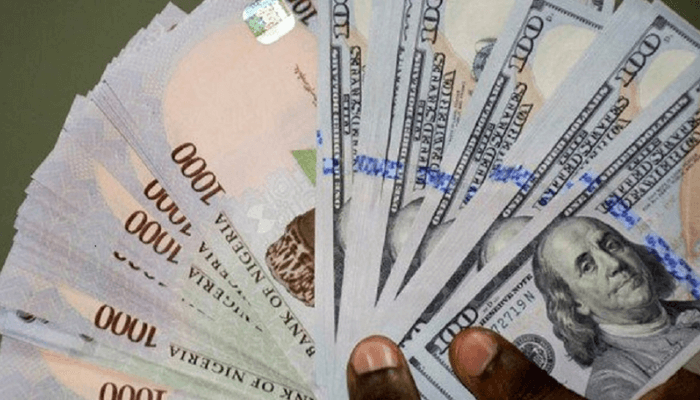
On Thursday, the naira aligned at N1,455 per US dollar in both the official foreign exchange (FX) market and the parallel market, effectively eliminating the previous disparity between the two rates.
Data from the Central Bank of Nigeria (CBN) shows that at the Nigerian Foreign Exchange Market (NFEM), the naira gained 1.4%, with the dollar trading at N1,455.23 on October 2, 2025, marking the first trading day of the month. This is a notable improvement from the N1,475.34 rate recorded on September 30, 2025, the last trading day of the prior month.
Similarly, in the parallel or black market, the naira appreciated by N40, equivalent to a 2.7% increase, closing at N1,455 on Thursday compared to N1,495 on Tuesday.
Throughout September 2025, the naira experienced a substantial rise in the official FX market, strengthening by N50.75 against the dollar overall.
Yemi Kale, Group Chief Economist and Managing Director of Research and Trade Intelligence at the African Export-Import Bank (Afreximbank), provided insight into Nigeria’s historical exchange rate framework.
“For an extended period, Nigeria’s exchange rate system was characterized by multiple rates and administrative controls. This opaque arrangement resulted in a significant gap between the official rate, which was around N450 to the US dollar at the time, and the parallel market rate, often exceeding N700. Access to the official, cheaper rate was limited to a select few, while the majority of businesses and consumers faced much higher costs. This environment fostered corruption and rent-seeking behaviors, discouraged authentic exporters and investors, distorted market signals, and made the naira vulnerable to speculative pressures,” he explained.
Kale further noted that the current, more transparent FX system has led to a surge in foreign portfolio investments (FPIs), which have contributed to short-term naira stability. However, he cautioned that foreign direct investment (FDI)-vital for job creation and expanding industrial capacity-may take longer to recover as investors remain cautious about the sustainability of reforms, especially given Nigeria’s history of policy reversals.