



Three years ago, fresh out of the University of Ibadan with a Bachelor’s Degree in Psychology, Olamilekan Oke decided against chasing a corporate job in Nigeria’s economic capital like most of his colleagues. Instead, he opted to make a living off the craft he had learnt while in school – shoemaking.
In his modest workshop-cum-showroom in the Ojo area of Lagos, his brand, ‘Feeted’, attracts loyal customers. His website and social media pages exhibit stylistic designs and images of footwear, a stark difference from his makeshift showroom. Olamilekan says he has ChatGPT and Canva to thank for the polished digital presence and brand marketing.
“I use Canva to create graphic designs for my social media pages, and I download, or I prompt ChatGPT to create model-like images,” Olamilekan says, scrolling through a gallery of brand images it prompted ChatGPT to create. He says he also uses the AI tool to create witty captions and names for his shoe designs before unveiling them on Instagram and X (formerly Twitter).
Olamilekan
He explained that he could not afford to employ models, photographers, or graphic designers like established brands. “These tools are very valuable to me. My brand is not big enough to hire models and photographers, so ChatGPT creates models for me and saves me costs.”
For many small-scale artisans like Olamilekan, artificial intelligence has become a survival kit in a brutally harsh economy, where the dream of formal employment fades for many graduates, and millions of youths choose between unemployment and making a living in the overstuffed informal economy.
According to the National Bureau of Statistics (NBS), roughly 92% of Nigeria’s workforce is in informal employment, while only about 8% of the working population is in formal/waged employment. The overwhelming reliance of the populace on the informal economy, without corporate support systems, suggests that low-cost and free AI tools, such as ChatGPT, Meta AI, and Canva, among others, used for marketing, ideation, and customer engagement, can transform the livelihoods of many.
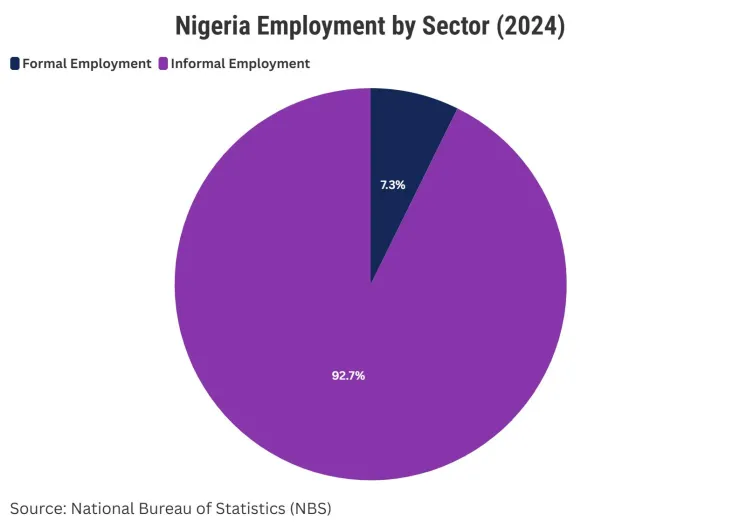
Over 90% of Nigeria’s workforce is in the informal economy
Artisans Focus on The Craft While AI Markets, Brands
Along the Egbeda expressway in Lagos, fashion designer Alawiye Habeeb sits at a sewing machine in his fashion studio, surrounded by half-finished suits and agbada. Like Olamilekan, his label, Kingshee Clothing, leans heavily on AI tools for marketing and customer relations.
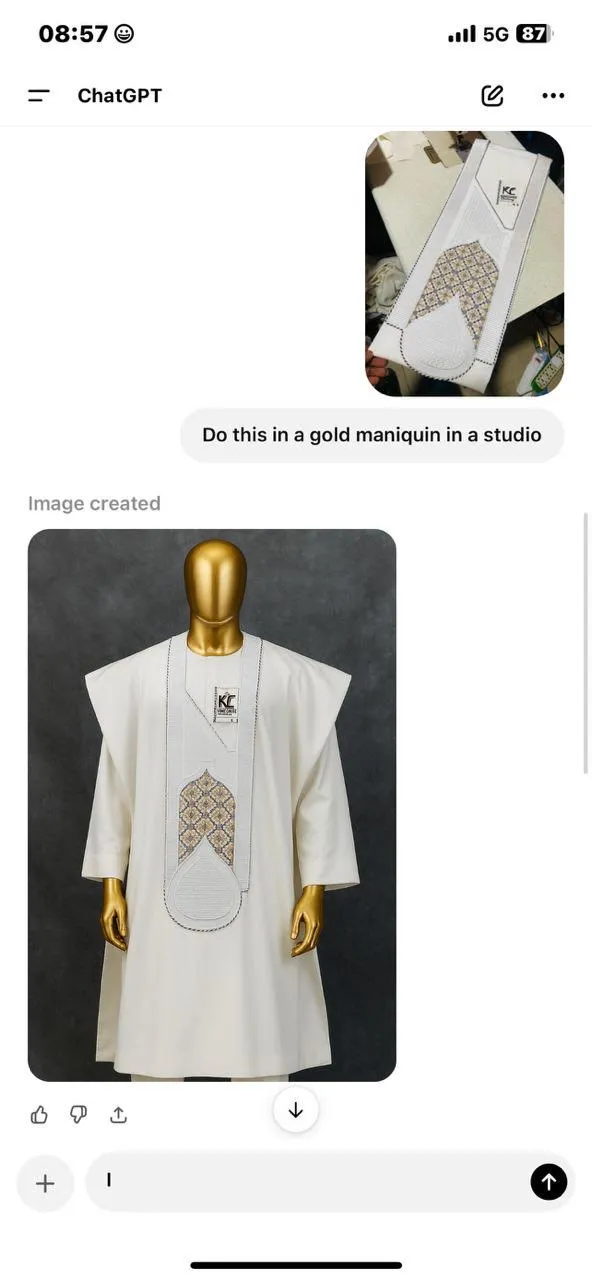
Alawiye prompts ChatGPT to model a newly made Agbada on a mannequin
“I use Meta AI to write warm messages for clients. It makes them feel valued, like they’re part of something special,” he explains. Alawiye also uses ChatGPT to generate sample designs for clients before cloth ever touches scissors. These are things big fashion houses hire PR officers or content writers for, but Habeeb lets AI fill the gap.
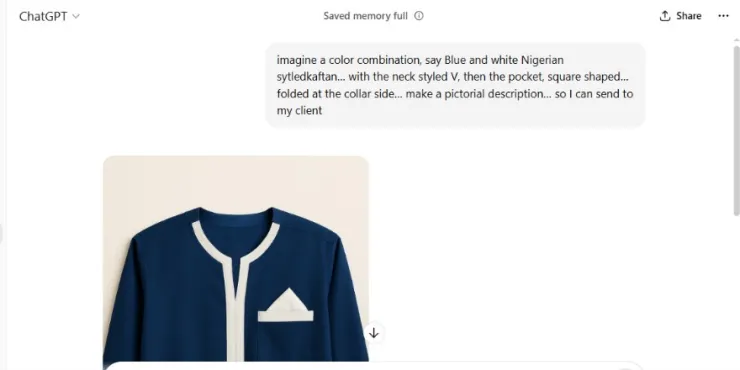
Alawiye prompts ChatGPT to generate design samples for clients
Prompting Is Now Part Of The Hustle
While global conversations around AI often revolve around automation replacing human labour, raising fears of job losses, Lekan, Alawiye, and many artisans in Nigeria’s sprawling informal economy are leveraging free and low-cost AI tools to defend their livelihoods and remain competitive.
Hustling for them is no longer just about sweat and long hours; it’s also about knowing how to prompt an LLM tool. AI helps them keep marketing costs low, turn around graphic designs faster, and maintain a somewhat professional image to their customers.
Back in Lekan’s workshop, strips of leather lie scattered on the floor. He picks up a pair of freshly stitched slides, photographs them on his iphone 12 Pro Max, and opens a new chat on ChatGPT. He asks it to “generate an image of a lady rocking these slides I made.” In less than five minutes, the generative AI tool returned a clean image of a dark-complexioned young lady rocking the slides and sipping a drink.

Olamilekan prompts ChatGPT to generate a model for his latest design
He further asks ChatGPT to suggest captions as he prepares to post the new AI-created model on his brand’s Instagram page. “It’s all part of the hustle,” he says with a smile.
However, Marketing Strategist and Consultant, Theophilus Alawonde, raised concerns over the effectiveness of AI by artisans and small-scale businesses, particularly its effectiveness in branding and marketing content.
Alawonde argued that there is a deluge of AI-generated content in emerging markets, so much that “You can’t differentiate Arike empire from Ashake empire because the branding assets are the same.”
He stressed that the tools are merely creating graphics and content that are similar in style and structure rather than brand identities because many users do not have the prompt engineering skills and patience to get the best out of AI for effective application in their businesses.
“People have different prompt engineering skills, people have different levels of understanding of branding, and people also have different access to these tools, whether it’s paid or free. And so these three things will unite to influence the inputs, and also go ahead to influence the outputs they get.
“In fact, I would also say the user’s patience will also influence because how many turns are you willing to go with the AI tool? Are you willing to do a back-and-forth? Do you just want to do like just garbage in, garbage out?
“And so we see cases where people just say, ‘this is what I do, I need this type of logo from you, and then the AI tool delivers something. Yes, it might deliver something glossy, and it will be good enough in the eyes of someone who has limited experience in branding. But then the assets won’t be effective in the sense that it’s just something blanket.”
He expressed concern over the saturation of AI-generated brand assets (logo, flyers, brand colours, posts, etc.), which are not informed by deeper brand identity elements. “So we don’t know what the brand stands for. We don’t know what the brand’s differentiation value is.”
Expert Advises Caution, Notes Gap in Digital Skills
Alawonde warns that while established brands can harness AI, emerging artisans risk losing their unique identity if they over-rely on AI or are unstrategic in its use.
“I would say it’s easier for made brands, it’s easier for brands with their name already known, to use AI tools than it is for brands that are just emerging, that don’t have a name yet. But if your brand is not yet known and you are overly reliant on AI for your creative output, it’s difficult to differentiate that brand from every other brand out there.
“It’s difficult because everyone starts to sound the same, everyone’s creative output starts to look the same because you ask ChatGPT, ‘I run the so-so-so business, suggest content ideas or create a content plan for me’, it’s the same thing it returns for everyone, there’s just minor tweaks. And most people do not spend the time to go back and forth to get something different, unique for their brand. They just go with the flow because most times people are trying to reduce the time they spend on the work.”
Meanwhile, many Nigerian artisans are being left behind in the adoption of AI, largely due to limited digital skills and inadequate internet access. Data from the Nigerian Communications Commission shows that internet penetration in Nigeria stood at 48.81% as of May 2025. This places the country behind at least 20 other African nations, according to a ranking by Statista.
Also, the World Bank reported that about half of Nigeria’s population lacks digital skills.
These gaps also inform Alawonde’s scepticism about the effectiveness of AI for emerging businesses and the informal economy; he calls for nationwide policies to improve digital skills and encourage AI adoption.
By Oluwatobi Odeyinka,
CJID AI and Tech Reporting fellow
This report was produced with support from the Centre for Journalism Innovation and Development (CJID) and Luminate
The post FEATURE… Hustle Culture: How artisans are tapping into AI to stay ahead appeared first on Latest Nigeria News | Top Stories from Ripples Nigeria.