


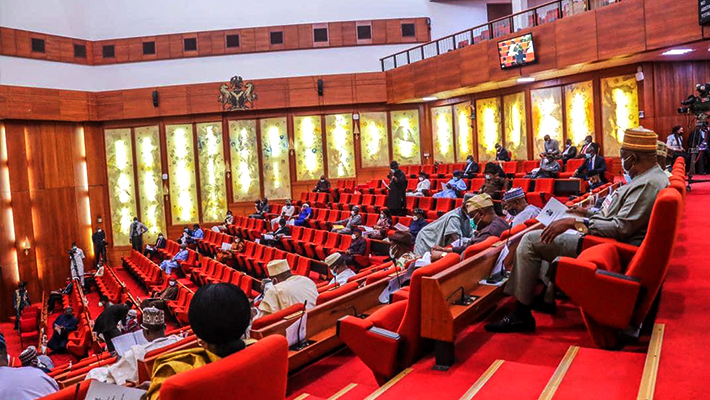
On Thursday, the Nigerian Senate firmly dismissed allegations of an ongoing genocide targeting Christians within the country, labeling such claims as misleading and harmful. The Senate resolved to actively engage with members of the United States Congress to address and correct what it views as a significant distortion of Nigeria’s security landscape.
This decision came after the Senate adopted a motion introduced by Senator Mohammed Ali Ndume of Borno South, with support from Senators Sani Musa (Niger East), Aliyu Wamako (Sokoto North), Ibrahim Bomai (Yobe South), among others.
The motion, entitled “Urgent Need to Address Misconceptions Surrounding the Alleged ‘Christian Genocide’ Narrative in Nigeria and Abroad,” cautioned against the exploitation of religious persecution narratives by foreign entities and advocacy groups for their own agendas.
Senator Ndume, while presenting the motion, acknowledged the tragic attacks on Christian communities but emphasized that Nigeria’s security challenges are complex and cannot be reduced to religious conflict alone.
“The insecurity we face stems from a combination of terrorism, poverty, banditry, and ethnic clashes, not solely religion. Branding it as a ‘Christian genocide’ misrepresents the facts, fuels division, and misleads international partners,” Ndume explained.
He expressed concern over recent discussions in the U.S. Congress, particularly regarding the proposed Nigeria Religious Freedom Accountability Act of 2025, which aims to impose sanctions on Nigerian officials accused of complicity in violence against Christians and other minorities, and suggests reinstating Nigeria on the Country of Particular Concern (CPC) list for alleged religious persecution.
Senator Suleiman Kawu of Kano South, a co-sponsor of the motion, criticized the U.S. legislative proposal as lacking accurate information and urged the Senate to protect Nigeria’s reputation through diplomatic engagement.
“In my own district, there are over 50 churches coexisting peacefully with other faiths. The narrative that Christians are being targeted systematically is unfounded. Both Muslims and Christians have suffered from terrorism and insecurity,” Kawu stated.
He highlighted several tragic incidents where Muslim communities were victims, such as the 2014 bombing of a mosque in Kano that resulted in over 250 deaths, and a mistaken airstrike in Kaduna that killed more than 100 worshippers during a religious celebration.
Senator Jimoh Ibrahim from Ondo South called for a more nuanced understanding of the terrorist groups responsible for the violence. He proposed a confidential Senate session to evaluate Nigeria’s counterterrorism policies and enhance diplomatic communication with the United States.
“Imposing sanctions only deepens poverty, which affects all Nigerians regardless of faith. We need informed engagement, a unified approach to counterterrorism, and to ensure the U.S. comprehends our realities,” Ibrahim remarked.
Presiding over the session, Senate President Godswill Akpabio supported the motion, underscoring that violence in Nigeria impacts citizens of all religions.
“When attacks occur in predominantly Christian areas, Christians suffer; when they happen in Muslim regions, Muslims are the victims. Terrorists do not discriminate by religion-they target Nigerians as a whole,” Akpabio affirmed.
The Senate committed to backing diplomatic initiatives aimed at fostering a balanced and factual portrayal of Nigeria’s security situation to international partners, including the U.S. Congress.
After thorough discussion, the Senate unanimously rejected the sweeping characterization of Nigeria’s security crisis as a Christian genocide. It also called on the Federal Government, through the Ministry of Foreign Affairs, to disseminate accurate data and context-sensitive information to counteract misinformation.
The Senate further resolved to engage U.S. lawmakers, diplomatic missions, and international media through official briefings to clarify the facts. It mandated the Committees on Foreign Affairs, Information, and National Security to collaborate with the Executive branch in crafting a coordinated national communication strategy.
Although Nigeria was removed from the U.S. Country of Particular Concern list in 2021, some American legislators are now reconsidering this status, citing ongoing violence against Christians. Nigerian senators, however, argue that such claims overlook the broader security challenges affecting all Nigerians, regardless of faith.
“Now is the moment for Nigeria to tell its own story,” Ndume concluded. “We must dispel this dangerous narrative before it undermines our international reputation and national cohesion.”