


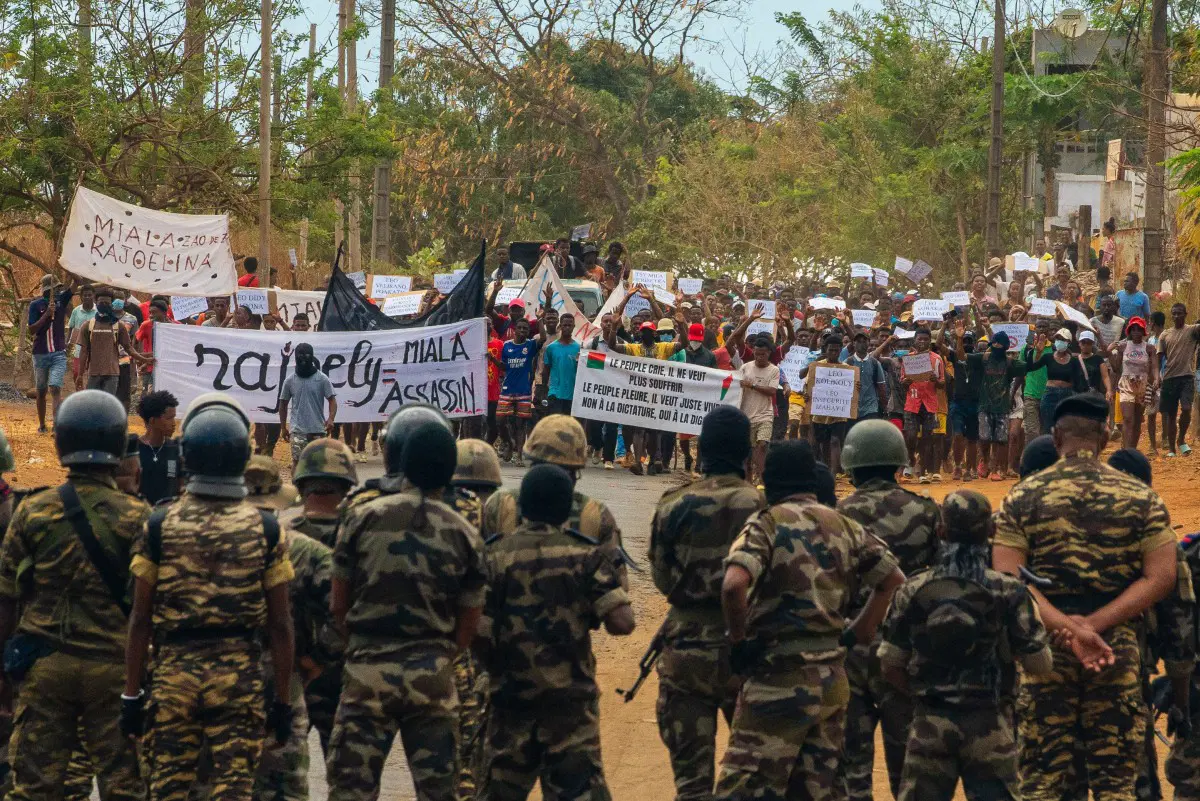
On Saturday, groups of soldiers in Madagascar aligned themselves with thousands of demonstrators in the capital city, according to AFP correspondents. These troops declared their refusal to follow any commands to open fire on the protesters.
The youth-driven protests in Antananarivo attracted significant crowds, marking one of the largest assemblies since the movement began on September 25 on the island nation in the Indian Ocean.
Authorities initially attempted to break up the crowds using stun grenades and tear gas. However, soldiers soon appeared at the core of the demonstration near Lake Anosy, where they were greeted with enthusiastic applause.
Protesters expressed their gratitude by shouting “Thank you!” as some soldiers waved Madagascar’s national flags, as captured in various images.
Earlier in the day, at a military base on the city’s outskirts, soldiers publicly vowed not to act against the demonstrators.
“Let us unite-military, gendarmes, and police-and refuse to be paid to shoot our own friends, brothers, and sisters,” the soldiers stationed in the Soanierana district declared in a video shared on social media platforms.
They urged their comrades at the airport to “stop all flights from taking off” and called on personnel in other camps to “reject orders to fire upon your fellow soldiers.”
“Secure the gates and wait for further instructions,” they instructed. “Disobey commands from superiors who order you to shoot your comrades-in-arms, as they will not protect our families if we fall.”
Saturday’s protests represented the most substantial turnout in recent days for the youth-led movement, which initially arose from frustrations over persistent power outages and water shortages but has since expanded into a wider anti-government campaign.
The exact number of soldiers who joined the protests remains uncertain.
Historically, the Soanierana military base played a pivotal role in the 2009 mutiny that led to a popular uprising, ultimately bringing the current president, Andry Rajoelina, to power.
In response to the unfolding events, the newly appointed defense minister urged the armed forces to maintain composure during a press briefing on Saturday.
“We appeal to our brothers who disagree with us to prioritize dialogue,” stated Minister General Deramasinjaka Manantsoa Rakotoarivelo.
“The Malagasy army continues to serve as a mediator and stands as the nation’s final line of defense,” he added.
– Escalation of Force –
On Thursday, security forces employed tear gas, rubber bullets, and armored vehicles to disperse protesters, resulting in multiple injuries.
Footage depicting police brutality circulated widely on social media, including a disturbing video showing a man left unconscious after being pursued and violently beaten by security personnel-an incident also witnessed by AFP reporters.
The United Nations responded on Friday by urging authorities to “refrain from excessive force and respect the rights to freedom of assembly and peaceful protest.”
The UN reported that at least 22 individuals lost their lives during the initial days of the protests, which were initiated by a youth movement known as “Gen Z.”
President Andry Rajoelina contested these figures, stating on Wednesday that there were “12 confirmed deaths, all of whom were looters and vandals.”
Initially, Rajoelina took a conciliatory approach by dismissing his entire cabinet in reaction to the unrest.
However, he later intensified his stance by appointing a military officer as prime minister on October 6 and selecting the first members of his new government from the military, public security, and armed police forces, declaring that the nation “no longer tolerates disturbances.”
Among the world’s poorest nations, Madagascar has experienced frequent mass uprisings since gaining independence in 1960. Notably, the 2009 protests led to the ousting of then-president Marc Ravalomanana, with the military installing Rajoelina for his initial term.
Rajoelina secured re-election in 2018 and again in 2023 through contested elections that were boycotted by opposition parties.