


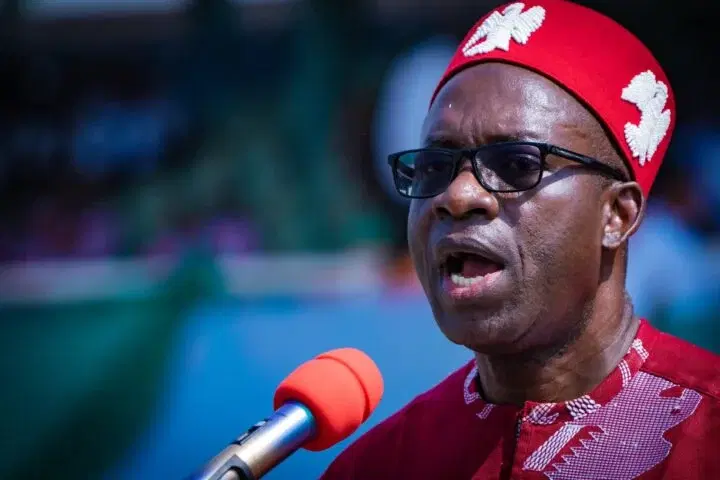
Professor Charles Soludo, the Governor of Anambra State and former Governor of the Central Bank of Nigeria (CBN), has expressed serious reservations about the Independent National Electoral Commission‘s (INEC) proposal to restrict its authority to review election outcomes.
He cautioned that such a limitation could weaken ongoing efforts to combat electoral malpractice and impunity.
Speaking virtually at the Athena Centre’s event reviewing INEC’s advancements in electoral technology from 2015 to 2025, Soludo praised the commission’s technological progress but voiced concern over the suggested amendment to Section 64 of the Electoral Act.
Currently, INEC holds the power to reassess election results declared under coercion or in violation of the Electoral Act or its own regulations. However, the commission is reportedly seeking to narrow this power exclusively to cases involving duress.
Soludo questioned the wisdom of this move, highlighting that Nigerians have long demanded stronger mechanisms to prevent politicians from manipulating the electoral process with impunity.
He challenged the logic behind curtailing INEC’s review capabilities, especially given frequent instances where collation officers announce results contrary to established procedures.
“It is troubling to consider shielding election officials when they blatantly disregard the law,” he remarked.
While acknowledging concerns that broadening the review process might overwhelm INEC with responsibilities better suited for the judiciary, Soludo insisted that the commission’s oversight must remain stringent enough to hold its officials accountable.
He advocated for a legal framework that ensures any INEC official who endorses collation results in violation of guidelines faces prosecution and imprisonment.
“Until we begin to jail even a few corrupt officials, there will always be individuals willing to risk their reputation and freedom for illicit gains,” he warned.
Soludo criticized the current practice where corrupt officials are often regarded as “experts” capable of manipulating results in one region before being reassigned elsewhere, identifying this as a core problem undermining electoral integrity.
He emphasized the necessity for complete transparency in the electoral process, allowing public scrutiny at every stage.
Describing his vision for an ideal electoral system, Soludo imagined a scenario where candidates win purely based on the electorate’s will, without needing connections to INEC staff or security personnel.
“The outcome should reflect the genuine choice of the people,” he asserted, framing this as the ultimate goal for Nigeria’s democratic development.
To realize this vision, he stressed the importance of vigilant political parties, citing a recent by-election where party agents successfully prevented the use of pre-filled ballots at a polling station.
Soludo also called for a comprehensive review of the role security agencies play during elections, reiterating his ideal of a process free from undue influence by officials or security forces.
While urging caution against viewing the electoral system as entirely flawed or flawless, he acknowledged Nigeria’s progress over the years.
He referenced the tenure of former INEC Chairman Professor Attahiru Jega, under whose leadership an incumbent government lost and accepted defeat-an unprecedented milestone in Nigeria’s electoral history.
“We have witnessed both successes and setbacks. It is crucial to appreciate the progress made while recognizing areas needing improvement,” he noted.
Soludo encouraged all stakeholders to pursue steady, incremental reforms, emphasizing that the journey toward a fully credible electoral system is ongoing.
“There is still significant room for rapid advancement, but we must remember our starting point and the destination ahead,” he concluded.