


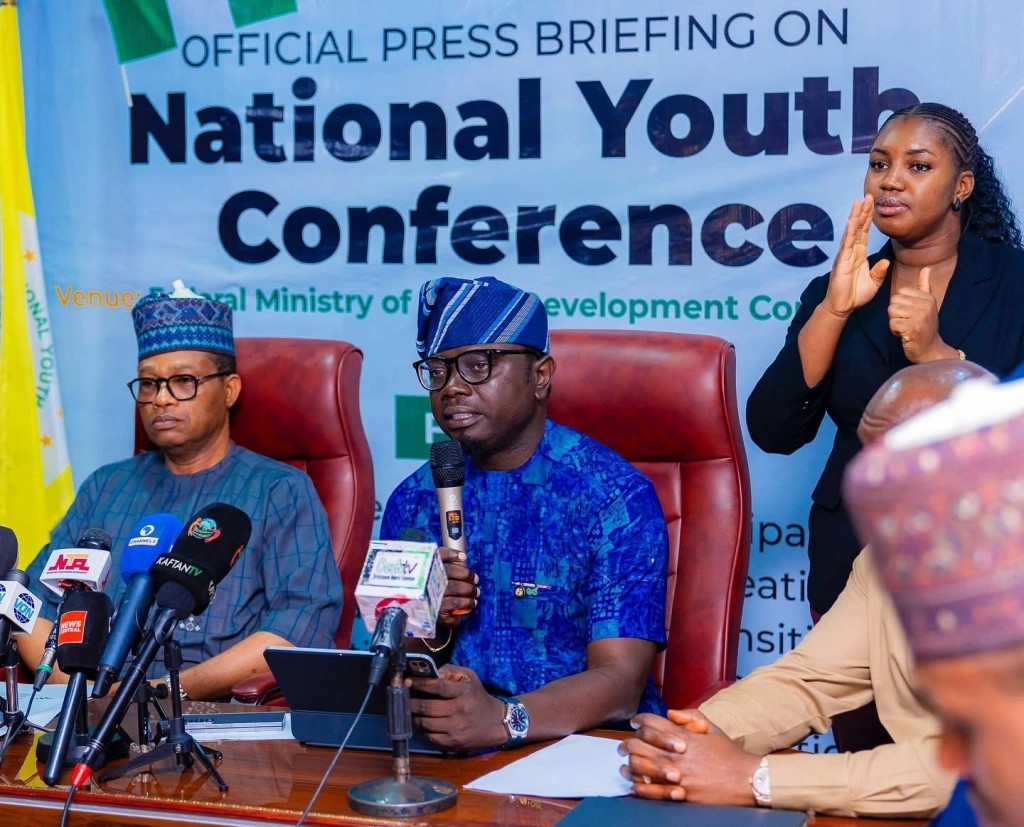
It is end of September 2025. Meanwhile Nigeria’s youth were supposed to converge for the National Youth Conference from July 7 to 21, 2025 in Abuja, but more than one question now dominates the theme of the conference, including: is it yet another fraud being perpetrated on the youths of Nigeria, is it government’s administrative inertia or is it the nature of the present government and it’s officials that has led to the present impasse?
How did it all began?
Despite its high-level official announcement in the President’s October 1, 2024 Independence Day broadcast, the National Youth Confab with a target date of February 2025 and submission of the Final Report to the President on August 12th, 2025 to tally with the International Youth Day, it remains a mirage. On June 16, 2025, the Federal Ministry of Youth Development launched the official digital infrastructure and registration portals for the Youth Confab. Nigerians were informed by the planning committee that 90 per cent of planning is completed but could not proceed without final presidential approval and essential security clearance, and if you check the 2025 budget, no specific provision for the Youth Conference was made!
Therefore, in search of a plausible answer, I looked at my submission to the Conference Planning Committee, my articles in a number of the national dailies and also my podcast address in BakondareSpeaks where I made a presentation titled ”A Youth-Led Roadmap to Stop Nigeria’s Bleeding Democracy” under the theme, Governance and Political Participation: how do we stop our haemorrhaging politics and rescue our dying democracy? And come to the realisation that it could be one of the reasons that made the renewed hopeless government suddenly develops cold feet and it’s unable to move forward with the confab.
In my submission to the Conference Planning Committee, I offer more than diagnosis, I propose an actionable plan to rescue Nigeria’s political exclusion crisis, where money bags hijack parties, delegates sell their conscience for peanuts, all other parties including the ruling party are uncoordinated and are basking in selfish interest, the political terrain is uneven and full of potholes, the elections are a winner-takes-all-scam, the IDPs and PWDs are disenfranchised lacking any relevance, and state electoral commissions mock accountability. These issuesdemandimmediate intervention and hence the for a Youth-Led Roadmap!
The issues:
Twenty-two years after shaking off military rule, Nigeria’s democracy remains critically ill. The symptoms are undeniable, including delegate buyout, obscene monetisation of politics fuelled by plundered public funds, monstrous INEC electoral subvention, abysmal voter turnout, rampant vote-buying, brazen electoral violence, and a pervasive sense of disillusionment, particularly among our youth. The diagnosis is exclusion. Our political space is systematically skewed, barring the door to equitable participation for young people, women, persons with disabilities (PWDs), internally displaced persons (IDPs), and the vast majority of political parties operating on fumes. This is not just unfair; it is a constitutional betrayal and a ticking time bomb for our nation’s stability and future prosperity.
Look around. Our democracy is captured by money bags and entrenched elite’s stranglehold party structures, shutting out fresh, credible voices, especially the youth who constitute our demographic majority. Internal party democracy is a cruel joke, decided in naira-filled rooms, not open primaries. Politics has become a prohibitively expensive auction, fuelled by a dangerous monetisation that sidelines principle and elevates corruption. The supposed umpire often lacks the independence or will to enforce its own rules.
The exclusion is systemic and scandalous. Internally displaced Nigerians, victims of conflict and instability, are routinely disenfranchised, denied their fundamental right to participate in shaping their own future. Minority groups are sidelined. Even at the grassroots, the charade of local government elections conducted by compromised state electoral commissions, like the travesties we have witnessed recently in local government council polls in Bauchi, Kaduna States and elsewhere, mocks the very idea of representative governance. This violates Section 14(2)(a), Section 15(1), Section 40, Section 153(1)(f), Section 221, Section 318(1), Seventh Schedule of the 1999 Nigerian Constitution (As Amended) and also Article 11, Article 17, Article 19, Article 27 of the African Charter on Democracy, Elections and Governance and Article 7, Article 21 of the UN Charter on Human Rights.
This status quo is unsustainable. Agitation from the sidelines is not enough. We need a concrete, actionable roadmap for inclusive political participation and accountable governance. These demands moving beyond rhetoric to structured reform, driven by the very groups currently marginalised.
Here is how our youth-led prescription will stop the haemorrhage and lead to democratic renewal:
A National Charter for Inclusion – We urgently need a National Multi-Stakeholder Political Participation Charter (NSPPC). To be developed collaboratively by the Federal Ministry of Youth Development, the Inter-Party Advisory Council (IPAC), INEC, Civil Society, and the Nigerian Youth Parliament, this Charter must establish minimum, enforceable standards. It should mandate and ensure genuine internal party democracy, guarantee equitable access and participation for all parties, and crucially, recognise, enfranchise, and provide free access to political platforms for youths, women, IDPs and other marginalised populations and importantly, multi-party participation in governance must be institutionalised, moving beyond the winner-takes-all mentality.
Root and branch party and electoral reform- All political parties must be forced into the light. We need legislation compelling all political office holders to publicly submit “Project Plans” before assumption of office and detailed “End-of-Term Reports”, real accountability, not empty promises. All Parties must adopt and enforce “Letters of credence” for candidates and not be misled by bank balances. Critically, the obscene monetisation fuelled by arbitrary, prohibitive nomination fees charged by state electoral bodies (like KAD-SIECOM’s infamous example) must be outlawed. Compliance with Section 7 of the Constitution and the Electoral Act 2022 regarding free and fair LG elections is non-negotiable and requires immediate enforcement mechanisms.
A digital democracy revolution – Leverage technology for transparency. Establish a “National Digital Democracy Hub (NDDH) “. This platform would monitor and publicly report electoral activities in real-time, track campaign finances (exposing illicit flows), and audit internal party processes. Crucially, it could host gamified civic education modules, making political literacy engaging and accessible, especially for young voters, combating apathy and empowering informed participation.
Empowering IPAC youth and grassroots mobilisation – The IPAC Youth Directorate, at national and state levels, must be formally institutionalised, funded, and mandated as vital civic intermediaries. Their role will be driving nationwide media literacy, political education, and democratic sensitisation campaigns, particularly targeting excluded groups. They are the bridge between formal institutions and the disillusioned populace.
What is the expected cure? It is a democracy that works, that will witness increased participation from youth, women, PWDs, and IDPs. A stronger internal party democracy, reduced electoral violence, reduced vote-buying, and impunity. With a better-informed electorate and transparent party structures. Ultimately leading to better governanceand accountability.
The implementation roadmap is clear and actionable:
Phase 1 – Draft the NSPPC in collaboration with all stakeholders.
Phase 2 – Develop and implement INEC-IPAC-CSO party audit guidelines.
Phase 3 – Launch the National Digital Democracy Hub and civic tools.
Phase4 – Amend the Electoral Act to codify the youth, IDP, and marginalised populace and all other policies formulated through this Youth-Confab process.
In conclusion
Already the vultures have started to cycle above the head of Nigerians in preparation to once again scam them come 2027 general elections.
The endless delay of the National Youth Confab exposes not just bureaucratic inertia, but a deeper incapacity of a government. I urge all well-meaning Nigerians to seize this roadmap I have laid out and embrace it wholeheartedly, for it is not merely a proposal but the panacea our wounded democracy so urgently needs.
Hon Rabiu (Bakondare) is a monitoring and evaluation specialist on policy, finance, risk, politics, good governance and an advocate for sustainable development. He wrote from Kaduna.