


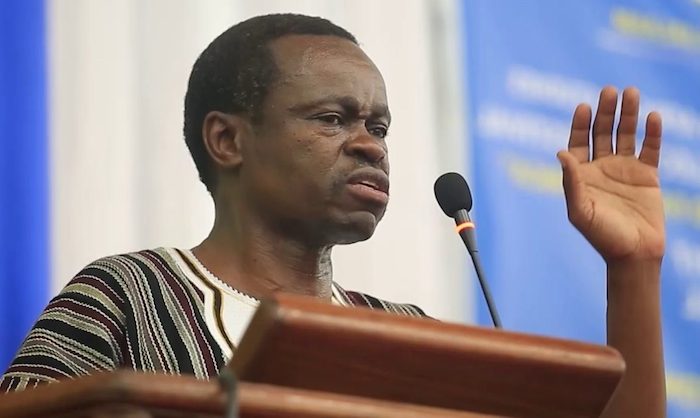
Esteemed Pan-African advocate and intellectual, Professor Patrick Loch Otieno Lumumba, delivered a powerful critique on Africa’s ongoing developmental challenges, casting doubt on the continent’s ability to fully capitalize on the African Continental Free Trade Area (AfCFTA) without a solid manufacturing base and reliable electricity supply. Speaking at Nigeria’s 65th Independence Day event held at Covenant Church in Lagos, Lumumba cautioned that Africa’s economic ambitions risk remaining mere illusions unless urgent action is taken to resolve the continent’s energy shortages and industrial stagnation.
Known for his passionate discourse on African unity and governance, Lumumba emphasized that free trade agreements are futile without domestic production capabilities. “We celebrate the African Continental Free Trade Area, but I ask, what goods will we exchange if we lack manufacturing?” he challenged. “How can we compete globally when the essential pillar of modern society-electricity-is erratic not only in Nigeria but throughout Africa?”
The Kenyan legal expert and former head of the Kenya Anti-Corruption Commission received enthusiastic applause as he highlighted Africa’s failure to provide consistent power despite years of investments and commitments. “Delivering stable electricity is not a complex task,” he asserted. “Yet, in our homes, hotels, and factories, the lights frequently go out. What curse or spell prevents us from supplying our people with the fundamental necessities of modern life?”
Nigeria, Africa’s most populous country and largest economy, has long struggled with a crippling power deficit that hampers productivity, raises operational costs, and diminishes living standards. Although the nation’s installed capacity exceeds 13,000 megawatts, actual distribution rarely surpasses 4,000 to 5,000 megawatts for its 200 million residents. Frequent outages force reliance on expensive generators, while successive governments promise reforms that seldom materialize. Lumumba framed Nigeria’s predicament as a microcosm of the continent’s broader challenges.
“Our misfortune,” he argued, “is not ignorance but a lack of determination, bravery, and visionary leadership dedicated to Africa’s progress.” He reminded the audience that other regions, once at similar developmental stages, surged ahead by prioritizing energy infrastructure and industrial growth. “When Asia was ascending, it understood that without electricity, industry cannot thrive, and without industry, prosperity remains out of reach,” he noted. “Africa must awaken from its slumber because the world will not pause for us.”
Throughout his address, Lumumba posed incisive questions exposing contradictions in Africa’s current trajectory. “If we cannot produce goods at scale, what will we trade under AfCFTA? Why does electricity, the cornerstone of industrialization, remain unstable despite decades of investment? Who benefits from Africa’s ongoing dependency and underdevelopment? Can we claim economic freedom without first securing energy independence?”
For many attendees, Lumumba’s remarks struck a chord on Nigeria’s independence anniversary-a moment to reflect on the nation’s journey since 1960. While political sovereignty has been achieved, economic self-reliance remains elusive. He urged Nigerians and Africans to view independence not just as a symbolic event but as a commitment to genuine self-sufficiency. “Sixty-five years of independence should mean more than celebrations; it should compel us to question why our youth seek opportunities abroad, why our factories lie idle, and why our power supply flickers like a fragile flame,” he said.
His speech also touched on a contentious debate surrounding AfCFTA, which launched in 2021 aiming to establish the world’s largest unified market. While hailed by policymakers as a milestone for economic integration, critics warn that without industrial capacity, Africa risks trading only raw materials and imported finished products. Lumumba echoed these concerns, insisting that Africa cannot compete globally if it continues to import goods it should be manufacturing domestically.
“In today’s world, we cannot afford to be a continent that exports coffee beans but imports coffee, exports crude oil but imports gasoline, or exports cotton but imports garments,” he declared. “That is not trade; it is dependency masquerading as progress.”
Addressing Africa’s youth directly, Lumumba called on them to break the cycle of underdevelopment. “Young Africans must hold their leaders accountable. They should demand not just promises but tangible results-consistent electricity, thriving factories, job creation, and a continent that manufactures rather than merely consumes,” he urged.
As his address concluded, Lumumba’s words elicited both standing ovations and deep contemplation. Many agreed that his insights transcended Nigeria’s Independence Day, touching the core of Africa’s quest for authentic development. “The success of AfCFTA and Africa’s dignity depend not on rhetoric but on our commitment to fixing fundamental issues,” he affirmed. “Without energy, there is no industry; without industry, no wealth; without wealth, no power. Without power, Africa remains a giant shackled.”
His speech has since ignited widespread discussion on social media, with many praising his boldness in confronting leadership failures. Others called on policymakers to urgently address the continent’s electricity crisis as a prerequisite for sustainable economic growth.
At 65 years of independence, Nigeria stands at a pivotal moment-celebrating nationhood while facing persistent developmental hurdles. Lumumba’s message at Covenant Church was unequivocal: Africa’s destiny cannot be outsourced. True prosperity will only be achieved by building the necessary infrastructure, industries, and energy systems to support lasting growth.