


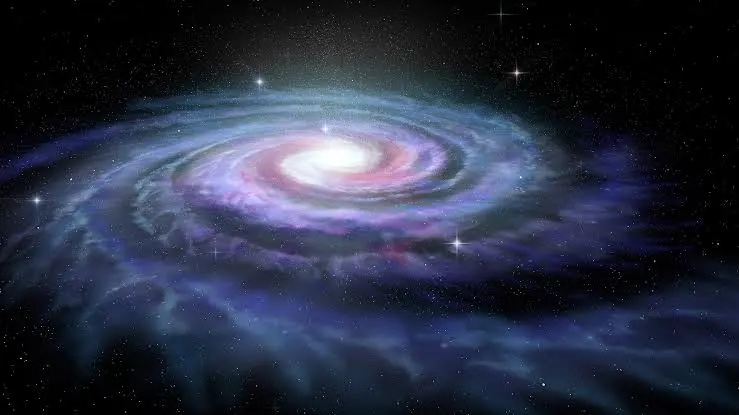
Contrary to the common perception of the Milky Way as a tranquil spiral of stars, our galaxy is actually experiencing dynamic movements resembling vast ocean waves. Billions of stars, including our Sun, are part of this cosmic dance, with stellar waves rising and falling thousands of light-years above and below the galactic midplane.
This groundbreaking insight comes from the European Space Agency’s Gaia mission, which has meticulously charted the positions and velocities of over a billion stars. Upon examining the latest dataset, scientists uncovered a remarkable phenomenon: a massive, wave-like oscillation coursing through the Milky Way’s disk, creating a ripple effect on an unprecedented scale.
Although Gaia concluded its data collection earlier this year, ongoing analysis promises further revelations about our galaxy’s complex behavior. This particular discovery was detailed in a collaborative study by European and American researchers, published recently in the journal Astronomy & Astrophysics.
READ ALSO: Atiku lambasts Tinubu over Plateau visit for burial of APC chairman, Yilwatda, mother’s burial
“What captivates us is not just the three-dimensional wave pattern visible in the star distribution, but also the coherent wave-like motions exhibited by the stars themselves,” explained Eloisa Poggio, an astronomer at Italy’s Istituto Nazionale di Astrofisica and lead author of the study.
Scientists hypothesize that this galactic ripple originated millions of years ago, likely caused by an interaction with a smaller satellite galaxy or a dense clump of dark matter passing through the Milky Way’s disk. Such an event would have generated gravitational disturbances, sending shockwaves that distorted the galactic plane much like a stone creating ripples on a lake’s surface.
These revelations challenge the traditional view of the Milky Way as a stable and static structure, instead portraying it as a dynamic and evolving system, still responding to ancient cosmic encounters.