


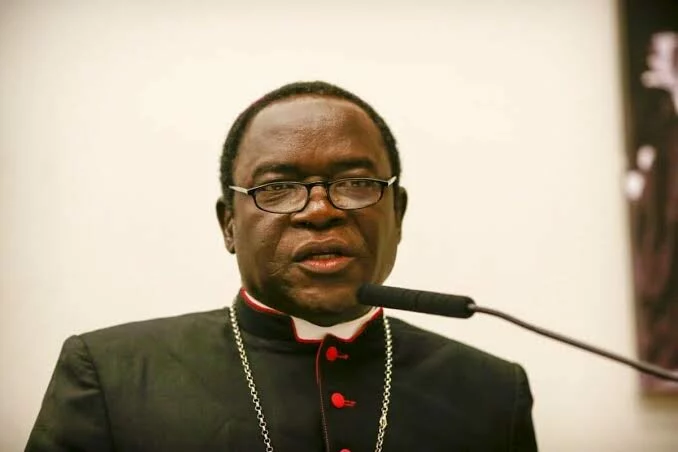
Mathew Hassan Kukah, the Bishop of the Catholic Diocese of Sokoto, alongside a coalition of prominent Nigerian figures, has issued a stern warning concerning the ongoing dispute between the Dangote Refinery and the Petroleum and Natural Gas Senior Staff Association of Nigeria (PENGASSAN). They caution that this conflict risks undermining investor confidence and could stall Nigeria’s ambitions to revitalize its domestic refining capacity.
In a joint communiqué released on Tuesday, the group-comprising twelve esteemed Nigerian leaders-acknowledged that government-led mediation efforts and renewed dialogue have helped ease tensions temporarily. Nevertheless, they stressed that such labor disputes could send negative signals to both local and foreign investors, potentially jeopardizing economic progress.
“We, the undersigned, express profound concern over the recent disruptions and unrest at the Dangote Refinery. Although government intervention and ongoing discussions between management and labor have provided some relief, this incident underscores vital lessons for Nigeria’s economic future,” the statement partially reads.
The coalition reflected on Nigeria’s persistent challenges, including the decline of state-owned refineries, the inefficient allocation of public funds through fuel subsidies, and the heavy dependence on imported petroleum products. These factors have historically contributed to fuel shortages, inflationary pressures, and increased insecurity for citizens.
“In this context, the Dangote Refinery represents more than a business venture; it embodies the promise of bold domestic investment to reshape the nation’s economic landscape,” they noted.
They further highlighted that the refinery has already begun to ease supply bottlenecks, with petrol prices reportedly dropping from ₦1,500 per litre to nearly ₦820 in some areas-a reduction of almost 55%. This decline has positively influenced transportation and food prices.
“The resulting decrease in transport and food costs offers Nigerians a clear example of how strengthening local production can improve everyday living standards. It also sends a compelling message to investors, both domestic and international, that industrial expansion remains achievable in Nigeria beyond speculative ventures,” the statement added.
However, the coalition warned that ongoing strikes and labor unrest amid such pivotal industrial developments could discourage vital investment.
“If not carefully managed, industrial disputes risk alienating both local and foreign investors at a time when Nigeria urgently needs capital inflows and innovative solutions. A refinery of this scale is crucial to the country’s economic wellbeing, impacting employment, energy security, and inflation control,” they cautioned.
The declaration was endorsed by notable personalities including education specialist Abubakar Siddique Mohammed, activist Aisha Yesufu, economist Arunma Oteh, investment banker Atedo Peterside, ECOWAS Commissioner for Political Affairs, Peace and Security Dr. Salamatu Hussaini Suleiman, Labour Party National Women Leader Dudu Mamman Manuga, Ibrahim Dahiru Waziri, Khalifa Muhammad Sanusi II (the 16th Emir of Kano), Obonganwan Barbara Etim James, Opeyemi Adamolekun, Osita Chidoka, and Senator Sola Akinyede.
The coalition advocated for a balanced approach that protects workers’ rights, sustains market stability, and enforces corporate accountability.
“Respecting workers’ rights is fundamental. The Constitution guarantees the freedom to organize and pursue fair treatment. No enterprise can flourish without a motivated and justly treated workforce,” they affirmed.
“Simultaneously, market integrity and productivity must be upheld. The right to organize should not be wielded as a tool to cripple the economy. Businesses that reduce costs and create jobs deserve safeguarding,” they emphasized.
“Corporate social responsibility and transparency must remain central. Investors of this magnitude are expected to operate with openness, uphold fair labor practices, and reinvest in the communities they serve,” the statement concluded.
According to LEADERSHIP, this cautionary message surfaced amid recent industrial action by PENGASSAN, which led to the suspension of key oil and gas operations following allegations that the Dangote Refinery dismissed 800 union-affiliated workers.
The refinery denied these accusations, clarifying that only a small number of employees implicated in sabotage were affected as part of an internal restructuring. Nonetheless, the strike triggered fuel shortages, decreased oil and gas output, and a nationwide drop in power generation.
The dispute was ultimately resolved through Federal Government intervention, with PENGASSAN calling off its strike after the Dangote Group agreed to redeploy the affected workers to other company divisions.
Despite this resolution, the price of cooking gas remains high, averaging ₦2,000 per kilogram in Lagos and other major cities as of Monday-more than double the pre-dispute rate of approximately ₦900 per kilogram.