


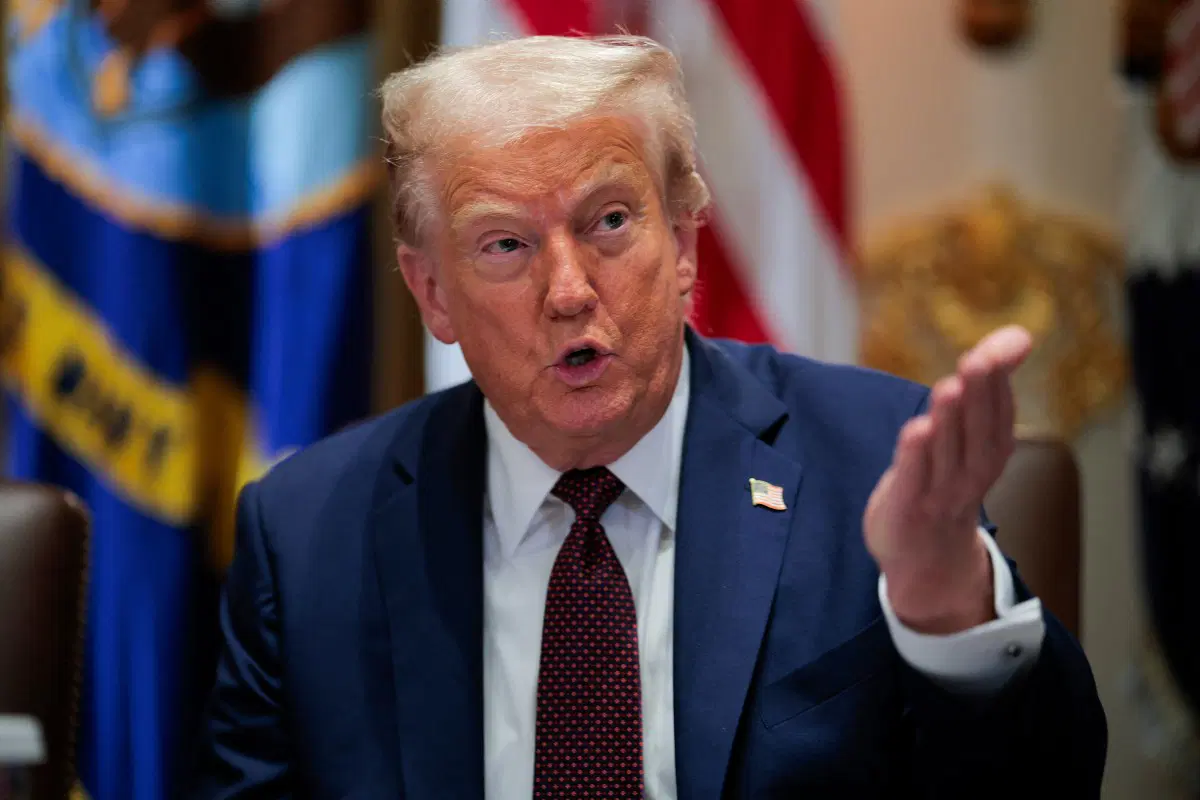
On Monday, President Donald Trump escalated his stance by threatening to invoke emergency powers under the Insurrection Act to send additional military forces into cities governed by Democrats. This move comes amid mounting legal obstacles challenging his efforts to deploy the National Guard in urban areas.
Trump openly discussed the possibility of activating the Insurrection Act following a federal judge in Oregon’s decision to temporarily block National Guard troops from being stationed in Portland. Meanwhile, a judge in Illinois permitted a similar deployment in Chicago to continue for the time being.
Both Portland and Chicago have experienced an influx of federal agents as part of Trump’s intensified immigration enforcement campaign, which has sparked protests near immigration detention centers.
“The Insurrection Act exists for a reason. If circumstances demanded it, I would not hesitate to use it,” Trump stated during a press briefing in the Oval Office. “If lives were at risk and courts or local officials obstructed us, I would absolutely take that step.”
Illinois authorities have filed a lawsuit aiming to prevent the National Guard’s deployment in Chicago. However, Judge April Perry, appointed by President Joe Biden, declined to grant an immediate restraining order, scheduling a comprehensive hearing for Thursday and requesting further details from the government.
The controversy intensified when it was revealed that Texas, under Republican leadership, planned to send 200 federalized National Guard members to Illinois-a decision that drew sharp criticism from Democratic Governor JB Pritzker.
“Texas troops have no business operating in Illinois,” Pritzker declared. He also condemned federal immigration agents conducting raids in Chicago, accusing them of “brutality,” “excessive force,” and unlawfully detaining American citizens.
- “Manufactured Fear and Disorder”
Trump’s remarks about the historic Insurrection Act came shortly after Governor Pritzker accused the administration of deliberately provoking violence to justify invoking emergency powers.
“The administration is following a familiar strategy: sow chaos, instill fear and confusion, and portray peaceful demonstrators as violent mobs by deploying tear gas and rubber bullets,” Pritzker explained at a news conference. “The goal is to manufacture a pretext for military intervention in our city.”
Despite opposition from Chicago’s mayor and other Democratic officials, Trump authorized the deployment of 700 National Guard troops to Chicago over the weekend.
In their legal challenge, Illinois Attorney General Kwame Raoul and Chicago’s legal representatives accused the president of weaponizing the military to “target political adversaries.”
“No American should live under the threat of military occupation simply because their local leaders have fallen out of favor with the president,” they argued.
During a joint press event, Raoul labeled the planned troop deployments as “illegal and unconstitutional, regardless of their origin.”
Homeland Security Secretary Kristi Noem defended the decision to send forces to Chicago, describing the city as “akin to a battlefield.”
Similarly, Trump has characterized Portland as “devastated by conflict,” though District Judge Karin Immergut temporarily blocked the National Guard’s deployment there, stating that the president’s justification “lacked factual basis.”
“Our nation is governed by constitutional law, not martial law,” Judge Immergut, a Trump appointee, emphasized in her ruling.
The administration has announced plans to appeal this decision.
A recent CBS poll revealed that 58% of Americans oppose the use of National Guard troops in domestic cities.
Illinois and Oregon are among several states challenging the Trump administration’s National Guard deployments. Earlier this year, California filed a lawsuit after troops were sent to Los Angeles to suppress protests triggered by immigration enforcement actions; that case remains active in the courts.