


When I first ventured into crafting fintech solutions specifically for the African market, I anticipated that the biggest challenges would revolve around technical issues like payment infrastructure, system integrations, and navigating regulatory frameworks. Yet, I quickly realized that the most significant barrier was far more elemental: establishing trust.
Users weren’t just looking for faster or more convenient ways to handle transactions; they sought confidence that the platforms they depended on would be dependable and secure. This insight reshaped my entire approach to design and has been a guiding principle in all my projects since, including initiatives such as Karla, HostFi, and other innovative startups.
1. Elevating Trust as the Cornerstone of Design, Beyond Functionality
At Karla, a fintech service offering contactless payment options for merchants across Africa, we discovered early on that users judged us less by the complexity of our technology and more by how secure and trustworthy the experience felt.
During our initial launch events and live demos, we observed that any hiccup in the user journey quickly diminished enthusiasm. Although many were keen to try Karla, the onboarding process-laden with multiple forms, identity checks, and ambiguous loading cues-led to a dropout rate exceeding 60%.
To address this, we redesigned the onboarding experience to focus on simplicity and trustworthiness. We condensed the process into three straightforward steps, supplemented by instant feedback and warm, approachable microcopy that reassured users at every stage.
Following these changes, completion rates soared to 85%, and repeat usage climbed by 40%. This underscored a critical insight: in fintech, trust is cultivated not only through robust security measures but also through a user experience that instills confidence at every interaction.
2. Crafting Solutions That Thrive Amid Infrastructure Challenges
Developing fintech products for African markets demands a deep understanding of infrastructural realities such as patchy internet access, unstable electricity, and widespread use of older mobile devices. Leading design at HostFi-a cryptocurrency platform that allows users to save, invest, and transact with stablecoins-I learned that startups that effectively accommodate these constraints build lasting user loyalty.
We reimagined onboarding entirely. Instead of overwhelming users with complex registration, we enabled account creation using just an email address-no delays, no exhaustive forms, no photo uploads. This allowed instant access even on slow or unstable networks. Users could then fund their accounts with either fiat or crypto, with all transactions cached locally to handle intermittent connectivity.
To balance user convenience with regulatory demands, we introduced a tiered KYC system. At Level 0, users could explore and deposit funds freely, while higher-value transactions and withdrawals required completing Level 1 KYC, which involved submitting identification and proof of residence.
3. Respecting Cultural Diversity and Tailoring to Local Realities
Africa is a mosaic of cultures, languages, and financial habits that shape how people manage money. Successful fintech design here means adapting solutions to local customs and expectations rather than applying a one-size-fits-all model-what works in Lagos may not resonate in Nairobi.
With Karla, we acknowledged the deep-rooted trust in bank transfers. Instead of trying to replace this behavior, we enhanced it by adding features like tap-to-pay and QR code payments, which sped up transactions without disrupting familiar routines. Our goal was to complement existing habits, making them more efficient and user-friendly.
At HostFi, we applied a similar philosophy. Many crypto platforms appear complex and intimidating, deterring everyday users. We adopted a finance-first design approach with clean layouts, intuitive navigation, and simple language, while keeping advanced crypto features accessible but unobtrusive. This made the platform inviting to a broad audience-from casual savers to experienced traders-in a space often seen as exclusive.
The essential lesson is that impactful fintech design in Africa is less about radical innovation and more about meeting users where they are and gently guiding them forward.
4. Championing Simplicity as a Fundamental Value
Complexity often alienates users. Many fintech teams overlook how intimidating financial jargon can be, especially for those new to digital finance.
At Karla, we initially described a feature as “Make payments with NFC.” While accurate, user feedback showed that only 20% understood this term.
We replaced it with “Tap to pay from your phone,” which significantly boosted clarity.
HostFi faced a similar hurdle with crypto terminology. Phrases like “Convert stablecoins to fiat” were swapped for clearer expressions such as “Exchange your Dollars for Naira.” The takeaway was simple: clarity builds trust, and trust drives engagement.
We also integrated visual storytelling, onboarding screens with relatable analogies, short explainer videos, and practical examples like “Send money to your cousin in Kenya instantly.” These improvements reduced user drop-off and made the platforms feel more accessible and relevant.
5. Redefining Accessibility as a Pathway to Economic Empowerment
In African fintech, accessibility extends beyond visual design elements like color contrast or font size; it fundamentally means enabling meaningful economic participation.
At HostFi, we found that the most effective way to foster trust was through transparency rather than motivational slogans. We introduced a feature that displays users’ portfolio values in real time across multiple currencies-Naira, Dollars, and stablecoins-removing hidden conversions and guesswork. Regardless of market volatility, users always knew their exact financial position in a familiar currency.
This seemingly small adjustment empowered users, especially newcomers, to see themselves as active participants in the financial ecosystem. When design transforms complexity into clarity, it encourages people to engage-whether sending money abroad, paying bills online, or making their first investments.
In Conclusion:
Across numerous fintech platforms, I have witnessed design accomplish what technology alone cannot: building trust in intangible financial services.
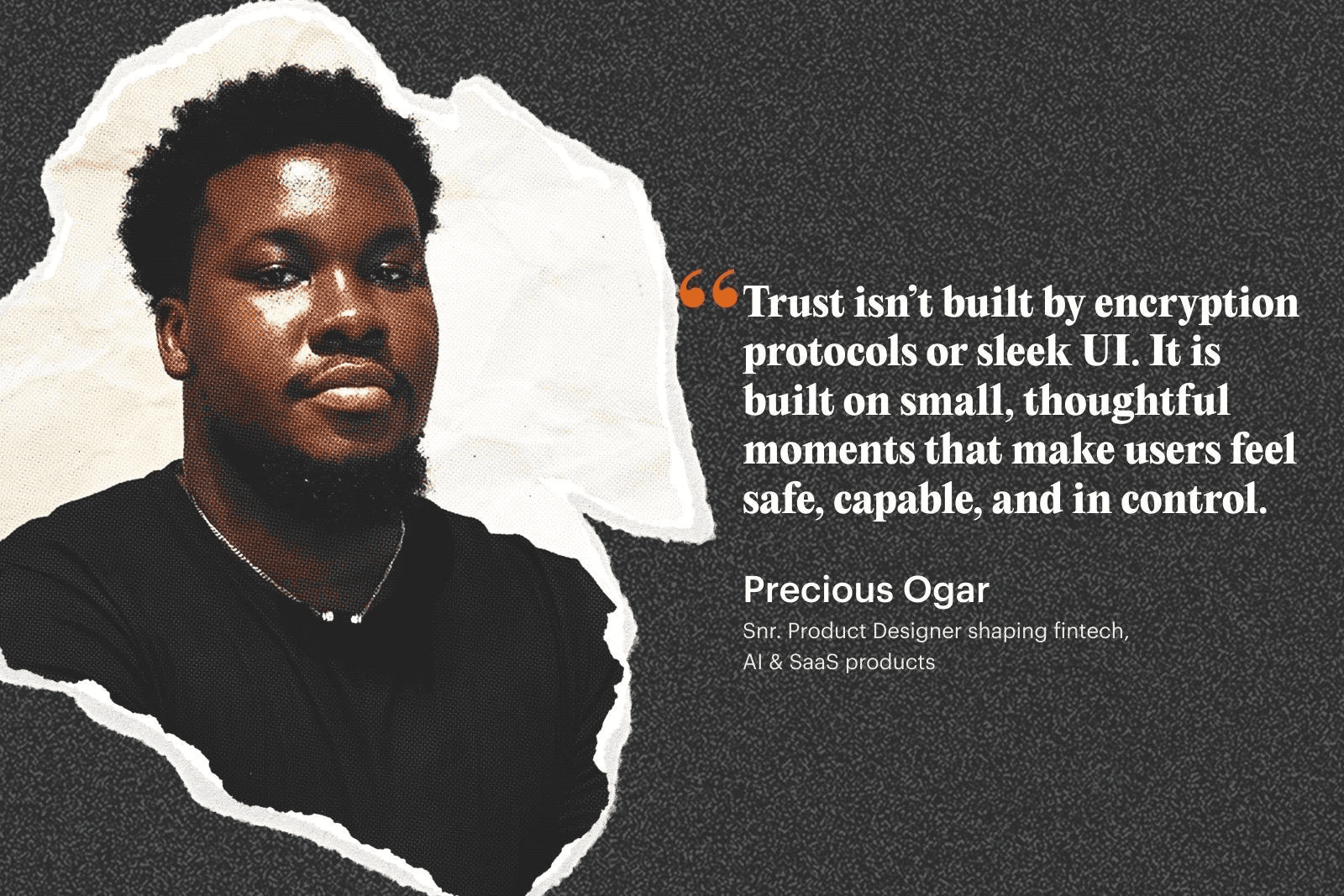
Designing fintech for Africa has taught me that genuine progress arises not just from innovation but from empathy and insight. Trust is not established solely through encryption or sleek interfaces; it is nurtured through thoughtful, incremental experiences that make users feel secure, empowered, and in control.
When fintech design can flourish amid uncertainty, communicate in local languages, and earn trust one interaction at a time, it achieves more than moving money-it moves belief.
This is how accessibility scales. This is how design fosters inclusion.
Precious Ogar is a Senior Product Designer with expertise in fintech, AI, and SaaS products. Working closely with Nigerian tech startups, he provides guidance on design and user experience in the AI era. Having led design teams across Nigeria’s fintech sector, he regularly facilitates design thinking workshops for tech leaders and UX professionals. In this article, he shares five key lessons to help technology leaders and UX designers develop products that users find intuitive and effective.