


By Clifford Ndujihe, Anayo Okoli, Dapo Akinrefon & Sam Oyadongha
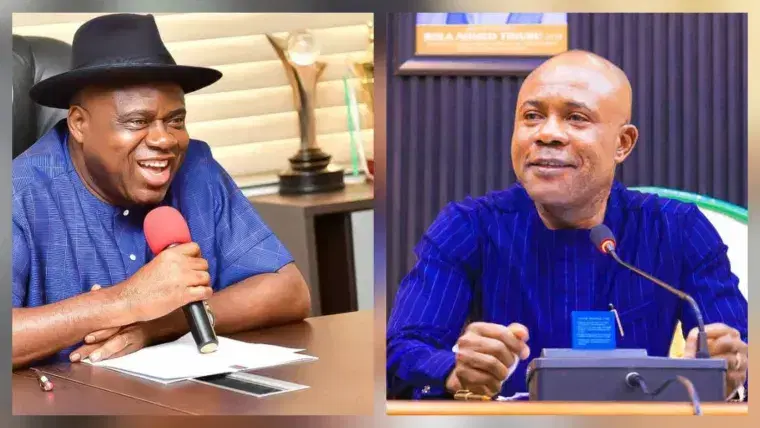
As Governors Peter Mbah of Enugu State and Douye Diri of Bayelsa State prepare to switch allegiance from the Peoples Democratic Party (PDP) to the ruling All Progressives Congress (APC), tensions are rising within their respective states.
Both governors, originally elected under the PDP banner, have reportedly finalized arrangements to join the APC, with an anticipated announcement slated for October 14. However, recent turmoil within the Enugu APC chapter may postpone these plans.
In anticipation of Governor Mbah’s arrival, the APC’s National Working Committee (NWC) took the unprecedented step last Thursday of dissolving the Enugu State Working Committee (SWC), appointing a caretaker committee headed by Ben Nwoye. While this caretaker committee is eager to embrace Mbah, the ousted SWC members contest the dissolution, asserting their continued legitimacy.
Meanwhile, PDP leadership in both Enugu and Bayelsa has remained tight-lipped despite repeated requests for comment.
Bayelsa Faces Internal Rift Over Diri’s Defection
In Bayelsa, Governor Diri’s impending defection has sparked mixed reactions among local stakeholders. Some argue that aligning with the APC-led federal government could bring increased federal support and development opportunities to the state. Others, however, view the move as politically motivated and question its impact in a state that has been a PDP stronghold for over two decades, with the party also controlling the federal government for 16 years.
A confidential source close to the Bayelsa government confirmed that preparations for Diri’s defection are underway but cautioned against the widely circulated October 14 date. “The governor has expressed his intention to leave the PDP, but the exact timing remains uncertain. He will make an official announcement in due course,” the source revealed.
APC Bayelsa Expresses Readiness to Welcome Diri
While PDP officials in Bayelsa declined to comment, APC Bayelsa State Chairman, Chief Dennis Otiotio, expressed enthusiasm about the potential defection. “Our party is open to any leader committed to advancing President Bola Tinubu’s Renewed Hope Agenda and supporting his 2027 re-election bid,” he stated.
“President Tinubu has delivered for the South-South region, and we encourage all governors here to unite behind him. We look forward to welcoming Senator Douye Diri whenever he decides to join us.”
However, another APC official, speaking anonymously, cautioned against speculation, noting, “We have not received any formal communication regarding the defection.”
Ijaw Leader Applauds Diri’s Move
Elder Joseph Ambakederimo, a prominent Ijaw leader and founder of the South South Reawakening Group, praised Governor Diri’s decision to join the APC. “I have long advised the governor to consider this path, and it appears he has heeded wise counsel,” Ambakederimo remarked.
He emphasized the importance of having political influence at the federal level, stating, “For our people to truly benefit and safeguard our interests, we must occupy positions where key decisions are made. Remaining in opposition limits our opportunities.”
Ambakederimo added, “This is a moment for bold action, not hesitation. The Ijaw community has been marginalized for too long. Aligning with the ruling party will open doors for federal appointments and economic growth beyond state politics.”
Critics Condemn Defection as Self-Interested
Conversely, Furoebi Akene, a development consultant and former Bayelsa Commissioner for Lands and Survey, criticized the move as self-serving. “Nigerian politics lacks integrity and accountability. Politicians often prioritize personal safety over public service,” he said.
Akene expressed dismay at the governor’s role in organizing the upcoming PDP convention while planning to defect. “Trust has long vanished from our political landscape. With a dysfunctional judiciary and selective anti-corruption efforts, many seek refuge in the ruling party to escape scrutiny,” he added.
Confusion Over Diri’s Choice
Jones Andaobo voiced bewilderment at the governor’s decision, noting, “It’s puzzling why a governor performing well would join a party that has struggled at the federal level.”
He observed that Diri’s entry into the APC could stabilize the party in Bayelsa, where internal leadership battles persist between Minister of State for Petroleum Resources Senator Heineken Lokpobiri and Chief Timipre Sylva. “Diri’s alliance with Lokpobiri could strengthen the APC’s position,” Andaobo concluded.
Enugu APC Exco Rebukes Dissolution
The dissolved Enugu State APC Executive Committee has vehemently opposed its removal, arguing that no constitutional violations or misconduct justified the NWC’s action.
In a detailed 12-point declaration, the 40-member Exco maintained that their election complied fully with the APC Constitution (2022, as amended). They contended that only the National Executive Committee (NEC), not the NWC, holds the authority to discipline or dissolve state party organs, and even then, only after due process involving the Zonal Executive Committee.
The statement highlighted that the NWC’s unilateral dissolution during its October 9 meeting was “illegal, unconstitutional, and an affront to internal party democracy.”
Furthermore, the Exco criticized the appointment of Ben Nwoye as caretaker chairman, noting he resigned from the APC in April 2025 and is thus ineligible to lead. They accused the NWC of rewarding disloyalty by reinstating suspended members known for anti-party activities.
The Enugu APC leadership urged all party structures within the state to maintain their positions and prepare to legally challenge the NWC’s directive, emphasizing the need to uphold fairness and due process within the party.
Bode George Decries Defections as Shameful
Former PDP Deputy National Chairman Chief Bode George condemned the governors’ planned defections as disgraceful and chaotic. When asked if intimidation influenced their decisions, he responded, “Whether or not they are pressured is irrelevant. Public servants must be accountable to their electorate.”
George warned against the emergence of a one-party state, calling it “the greatest failure for Nigeria.” He criticized the APC’s governance, highlighting widespread public dissatisfaction and hunger.
“Governors abandoning their parties without consulting their constituents is both disrespectful and destabilizing,” he said. “They owe the people an explanation for their shift to the APC.”
He concluded with a stern reminder: “The APC may not operate like the PDP, but Nigerians will make their voices heard in 2027.”