


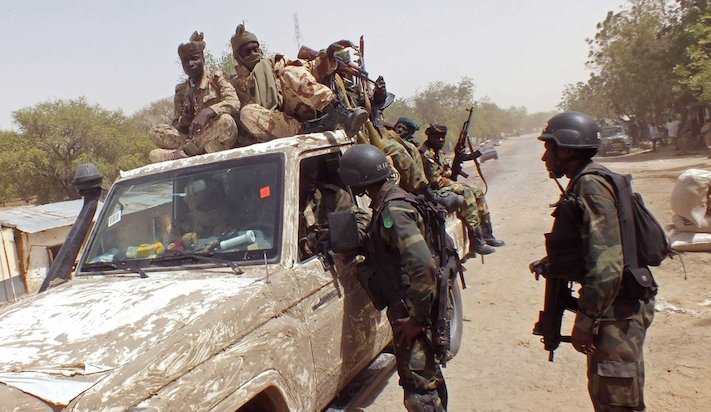
Good morning, Mr. President. I wish to commend the bravery and dedication of our courageous men and women serving under the command of General Christopher Musa, Chief of Defence Staff, who are actively confronting insurgents and terrorists on the frontlines. This achievement is a testament to your leadership as the Commander-in-Chief of the Armed Forces. Once again, I extend my heartfelt congratulations to these valiant officers and soldiers.
Despite ongoing operations aimed at eliminating terrorist threats that challenge our nation’s sovereignty, the conflict zone continues to expand, placing immense strain on our military resources. The insurgent groups occupying ungoverned territories are multiplying: from Boko Haram to the Islamic State West Africa Province (ISWAP), Ansaru, Lakurawa (linked to the Islamic State Sahel Province active in Mali, Niger, and Nigeria’s Kebbi and Sokoto states), and the Mahmuda faction in Kwara State. These groups are aggressively seizing control, with kidnappings and killings showing no signs of abating. Disturbingly, many of these hostile elements are foreign nationals, whose unchecked entry was facilitated by political actors aligned with your party back in 2015.
In Kwara State, terrorists have overrun numerous southern towns and villages, including Ologomo, Ajegunle, Agban, Alebe, Owode, Alasoro, Alawan, Bankole, Oreke, Ganmu, Babanla, Ayetoro, Budo, Arifowomo, Apata Olosun, Oreke Isale, Sagbe, Olohun Tele, Oke-Ode, and Ilu-Agunjin. While state authorities are intensifying counterinsurgency efforts, the militants are simultaneously consolidating their forces. Recent intelligence indicates a growing alliance between Boko Haram factions, particularly the Bakoura Dogo group, and ISWAP.
A discernible pattern links this resurgence to illicit mining activities. In Plateau State, the sites of frequent violent incidents are scattered with tin dust, underscoring that the conflict is largely driven by land grabs for illegal mineral extraction. Governor Caleb Mutfwang aptly described the situation as “not merely a farmer-herder dispute but a calculated and orchestrated campaign.” He further suggested that external sponsors profit from exploiting communities devastated by violence. This narrative extends beyond the usual farmer-herder clashes, as the epicenters of violence coincide with mineral-rich areas in the Northwest and Middle Belt regions. For instance, the violence in Niger State has been connected to Chinese-affiliated miners allied with the Dogo Gide terrorist faction, highlighting a troubling collaboration between local insurgents and foreign interests.
Addressing these threats demands unwavering political resolve. The extraction of gold, tin, lithium, and other critical minerals has emerged as a central factor fueling the conflict. Reports from Oke-Ode in Kwara State reveal that invaders warned residents to evacuate before excavating the land in search of precious metals. This operation involves both domestic and international actors, with Chinese and French entities frequently implicated. Mr. President, we risk descending into a situation reminiscent of the Democratic Republic of Congo’s resource-driven conflicts-a dire outcome for the aspirations of the African continent.
It is imperative that all stakeholders unite decisively to eradicate this menace. The incursions into our territory call for immediate reinforcement of security measures and strategic interventions. The proliferation of ungoverned zones and inadequately equipped security personnel must be urgently addressed, alongside the swift identification and neutralization of internal collaborators. Time is critical-mobilize all available resources and political determination to confront and eliminate this threat.
Mr. President, what steps should be taken? Our armed forces are currently limited in size and resources relative to the population. However, simply increasing troop numbers may not suffice. Instead, adopting a strategy akin to the Rumsfeld Doctrine could prove effective. Donald Rumsfeld, who served as U.S. Secretary of Defense under Presidents Gerald Ford and George W. Bush, advocated for a lean, agile military force capable of rapid deployment and precision engagement. Following the September 11 attacks, he emphasized the importance of readiness and the use of Light Armored Vehicles (LAVs) for reconnaissance, supported by targeted airstrikes to neutralize threats. Post-conflict stabilization would then be maintained by a robust civilian police presence.
In this context, I recommend expanding the police force, potentially through the establishment of state police units governed by a transparent democratic framework to prevent misuse by local authorities. The Amotekun security outfit in the Southwest serves as a promising model. Increasing police recruitment and effectively dismantling the networks supporting insurgents will foster deterrence. Additionally, diplomatic and soft power measures should be employed to counter external influences.
Foreign entities interested in our mineral wealth should be formally licensed to operate within Nigeria, thereby generating employment and economic growth. If we acknowledge that Nigeria is engaged in a form of warfare, then our response must encompass not only military action but also public relations campaigns, psychological operations, legal measures, and a sustained effort to alleviate poverty. Winning the battle for public perception is as crucial as defeating insurgents on the ground.
Finally, Mr. President, I urge you to prioritize national security above the distractions of the 2027 electoral campaign. With steadfast governance and focused leadership, victory in the upcoming election will naturally follow, God willing.
Prof. Akhaine, Department of Political Science, Lagos State University.