


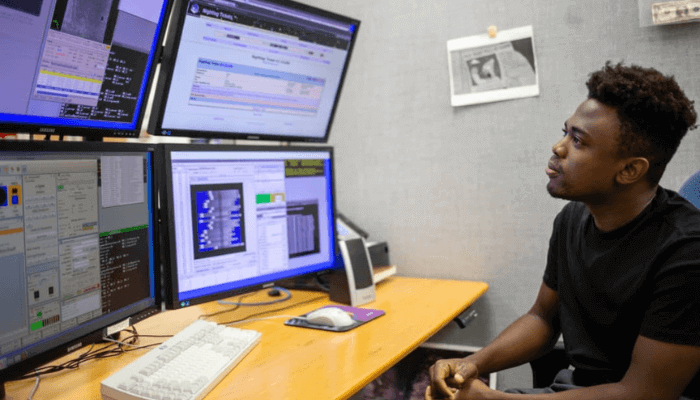
The global scarcity of computational power is one of the most significant bottlenecks in scientific and AI development. In a tech industry increasingly obsessed with AI abstractions and low-code tools, Abraham Ojima has chosen a different frontier.
He wants to get closer to the machine. He sees a widening gap between software and the hardware beneath it, a gap that limits scientific discovery, slows innovation, and creates barriers for researchers in under-resourced environments.
“We are seeing a drift away from fundamentals,” says Abraham, the Nigerian-born software engineer and distributed systems expert. “Engineers are building on top of so many layers of abstraction that we are losing the ability to squeeze maximum performance out of our hardware. And for scientists and developers in resource-constrained environments, efficiency isn’t a luxury. It is a necessity.”
Abraham has made it his mission to reverse this trend.
Over the last several years, Ojima has emerged as one of the few young engineers building tools that reconnect software with hardware’s true potential. Through strategically released open-source projects, he is doing exactly that, positioning himself as a key figure in the global high-performance computing ecosystem.
This is now helping researchers, developers, and scientists stretch limited computational resources farther than previously thought possible.
One of Abraham’s most important open-source projects is chronos, a C++ utility that addresses a growing bottleneck in modern tech, access to GPUs.
As AI models explode in size, Graphics Processing Units, or GPUs, have become one of the world’s scarcest digital resources. By leveraging OpenCL for integration across platforms, chronos allows a single GPU to be time-shared by multiple users or applications.
Rather than merely queuing jobs, it manages scheduling at a systems level so that expensive hardware can be used more efficiently.
For a researcher in Lagos or a student in São Paulo, chronos offers a practical way to run GPU-based experiments without dedicated clusters.
“It’s about efficiency,” he explains. “If we can write code that manages memory and scheduling at a low level, we can multiply the utility of the hardware we already have. We don’t always need more chips; sometimes, we just need better systems engineering.”
Beyond its technical design, chronos has important implications for countries like Nigeria that are racing to compete on the global stage in artificial intelligence and machine learning. Nigerian universities and companies often lack access to large GPU clusters, the very infrastructure that powers modern AI research.
By enabling multiple users to share a single GPU more efficiently, chronos can lower the effective cost of advanced computation. It gives emerging labs and startups a more accessible way to train models, run experiments, and participate in international research.
In a moment when nations are increasingly defined by their computational capacity, tools like chronos help countries such as Nigeria take more meaningful steps toward the frontier of global innovation.
Ojima’s belief that “Science should be limited by your ideas, not your tooling” extends to his work in astrophysics. He is the lead developer of stacked-seds, an open-source library that standardises the complex analysis of faint galaxy images. Before its release, research groups often had to write bespoke, inefficient scripts to process their data.
Stacked-seds provides a professional, optimised standard and has already been used in collaborative research on low-mass galaxies, helping lower the barrier to entry for serious astronomical work.
His work carries significance far beyond individual software projects. By building tools that maximise hardware efficiency, standardise scientific workflows, and expand access to high-performance computing, he supports researchers and engineers around the world, especially those in resource-limited environments.
His contributions help lower the cost of innovation, strengthen digital infrastructure, and give emerging economies like Nigeria a better chance to compete in global AI and scientific computing. In a time when the ability to do more with less defines technological leadership, he is helping shape a future where efficiency, accessibility, and high-quality engineering are more widely available.
Abraham’s work is unified by a single thread: a deep respect for the “metal”, the physical hardware that powers our world. By building open-source tools that optimize how software talks to that hardware, Abraham Ojima is doing more than just writing code. He is building a foundation that allows others, from astrophysicists to AI researchers, to build the future.