


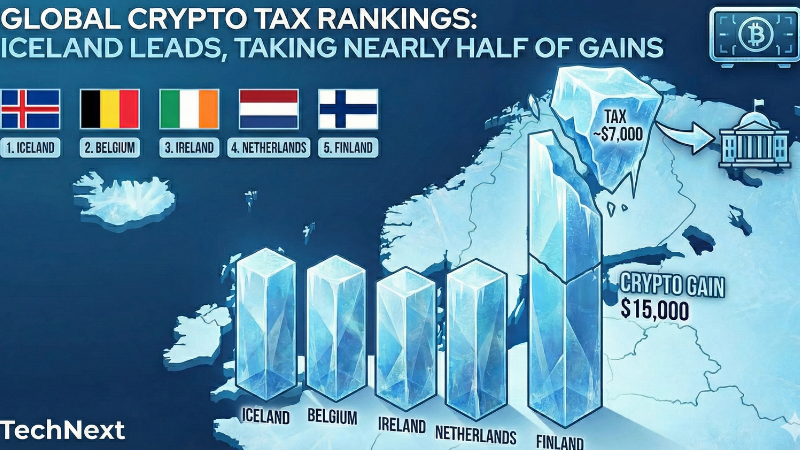
Iceland has been named the world’s highest tax jurisdiction for cryptocurrency investors. A new analysis by trading platform Atmos indicates that the country will take $6,900 from every $15,000 of capital gains. That will leave an investor with just $8,100 in net profit.
Atmos examined tax rules in 48 countries. It modelled a uniform $15,000 capital gain and ranked governments by the total tax collected under local rules. The aim was to show where crypto gains are most heavily taxed and where investors keep the least.
The analysis highlights how national tax codes treat crypto differently, as capital gains, income, or a hybrid, and how that classification changes outcomes for holders.
Iceland sits firmly at the top of the list. The Nordic nation applies a progressive tax structure to crypto gains. Profits up to $7,000 are taxed at 40 per cent, with gains above that threshold taxed at 46 per cent. Combined, this leaves investors with just $8,100 from a $15,000 gain.
The report also notes that Iceland’s crypto ownership rate is only 0.97 per cent, suggesting that steep taxation may be discouraging broader adoption.
Europe dominates the upper end of the ranking. Nine of the ten most heavily taxed countries for cryptocurrency gains are based in the region. Belgium takes second place, charging an estimated $4,950 in tax on a $15,000 gain.
Belgian authorities classify crypto activity in different ways, which can move the tax burden anywhere between zero and 50 per cent depending on whether trading is deemed speculative or professional. Despite that complexity, the country shows modest adoption levels, with 1.4 per cent of the population holding crypto assets.

Ireland matches Belgium in cash terms. A flat 33 per cent capital gains tax means Irish investors also hand over $4,950 on a $15,000 crypto profit, keeping $10,050 after tax. Crypto ownership remains low, at just 1.1 per cent of the population, reinforcing a broader pattern among high-tax jurisdictions.
The Netherlands ranks fourth, applying a 31 per cent effective tax rate on cryptocurrency gains under its wealth tax framework. Investors pay around $4,650 for a comparable gain. However, adoption is noticeably stronger.
Roughly 2.8 per cent of residents now own digital assets, amounting to nearly half a million people.
Finland completes the top five. The country uses a two-tier capital gains tax system, charging 30 per cent on profits between $1,000 and $30,000, and 34 per cent beyond that. On a $15,000 gain, the tax bill comes to $4,500, leaving $10,500 in net returns. About 1.4 per cent of Finns hold cryptocurrency.
Also read: Crypto mining: Africa is missing out on a key pillar of the global digital economy
Balancing crypto taxation with keeping investors within your shores
Atmos’s chief executive, Nick Cooke, framed the findings as a warning to tax authorities. He argued that crypto is unusually mobile and that steep taxes can drive capital and talent to more welcoming jurisdictions.

In his view, countries that strike a balance, levying reasonable taxes while preserving a hospitable regulatory environment, will attract the economic activity that governments ultimately hope to tax.
The report thus reads as both a snapshot of current policy and a suggestion about future jurisdictional competition.
Beyond Europe, the analysis highlights where tax revenue potential is largest. India stands out not because it taxes gains more heavily per se, but because of sheer scale. With an estimated 93.5 million crypto owners, India represents the biggest pool of taxable activity in absolute terms.
The combination of mass adoption and a 30% tax rate on certain crypto transactions points to enormous revenue potential for the Indian treasury, at least on paper. That statistic about user numbers aligns with independent market tallies that list India near the top of global crypto ownership figures.
The report raises two clear policy questions. First, how should governments balance revenue needs against the risk of pushing crypto activity offshore? Second, at what point does high taxation undermine the very base it seeks to tax by suppressing adoption and encouraging tax avoidance?
Atmos suggests that excessive taxation risks encouraging capital flight and the relocation of services to lower-tax jurisdictions.

For investors and advisers, the message is practical. Tax outcomes vary widely by country and by how local authorities classify digital asset gains. Jurisdiction matters. So do legal definitions and reporting regimes.
For policymakers, the study underlines the growing importance of consistent, clear frameworks that capture revenue without driving away innovators.
The Atmos analysis adds weight to debates about how to tax a highly mobile asset class while protecting domestic competitiveness in the digital economy. This, for me, is the lesson Nigeria must learn as the new tax regime comes into effect from January 2026.