


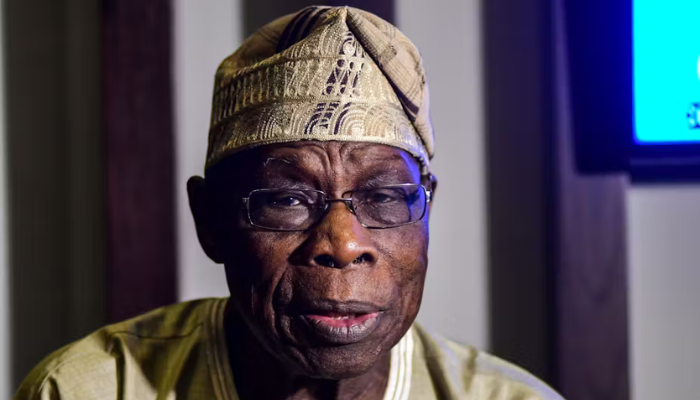
Former President Olusegun Obasanjo has urged leaders across the country to put Nigeria’s long-term interest above short-term political or personal gains.
He said good leadership must be anchored on honesty, courage and a commitment to policies that outlive individual tenures, noting that national progress can only be achieved when leaders think strategically and strengthen institutions rather than personalities.
Obasanjo delivered the remarks virtually at the Second Bi-Annual Honours Awards and Dinner of the Alumni Association of the National Institute for Policy and Strategic Studies (AANI), Lagos chapter, held in Lagos on Tuesday.
He said the association must use its platform to promote inclusive development and deepen democratic practice, adding that the country needs leaders who can mentor younger Nigerians and prepare them for public service. Obasanjo, who received a Special Recognition Award through a representative, urged members to invest in grooming young people, saying: “Invest time in young Nigerians. Build their capacity, teach them ethical leadership and encourage their participation in public offices.”
He noted that true progress depends on strong institutions that guarantee transparency, accountability and resilience. According to him, Nigeria’s development trajectory will only improve when policies are shaped by long-term thinking and when leaders place national interest above all else.
Omolara Balogun, chairman of AANI Lagos, said this year’s award ceremony comes at a time of profound global and local changes, underscoring the need to shine a searchlight on policy, public service and personal responsibility to actualise the future Nigerians desire. She said the ideals of the National Institute are reflected in the event, which highlights a shared responsibility to signal what truly matters for national growth.
Balogun added that building a better society has always been the primary goal of governance, noting that the founding fathers envisioned the National Institute as a platform that brings together leaders from the armed forces, intelligence community, public service, private sector, academia, professional bodies and civil society to collectively work on transforming Nigeria from a country into a fair and equitable nation.
She said those who pass through the National Institute earn the distinction of being addressed as mni—members of the National Institute—but beyond the title, they carry a lifetime obligation to promote the ideals of a better society. She explained that mnis across state chapters engage their communities through thought-driven interventions that support governance, noting that over the past 47 years the institute has recorded varying levels of impact, relevance and fulfilment of this mission. In Lagos State, she said, this work continues as members strive to bridge the gap between ideals and implementation, aligning with the broader national pursuit of progress.
Babajide Sanwo-Olu, governor of Lagos State, received a Distinguished Service Award, alongside Ayo Omotayo, director-general of the National Institute for Policy and Strategic Studies, Kuru. Fola Adeola, co-founder of GTCO Group, received the Policy Execution Award, while Proshare LLC was honoured with the Institution Award, among several others recognised by AANI.
Speaking with journalists after the event, Jimmy Agbaje, one of Nigeria’s prominent politicians, reflected on the purpose of the leadership development programme, describing it as an ideal framework for strengthening policy and strategy in the country. He expressed concern that Nigeria has not fully utilised the talent produced by the programme, despite the abundance of skilled individuals who could contribute meaningfully to governance.
He said politics may be hindering the proper integration of graduates into governance structures, noting that although the programme produces individuals with deep knowledge and experience, their impact has not matched their potential. According to him, many graduates possess valuable material and expertise, yet their utilisation remains low, even though some are recognised through awards.
Agbaje called on government and the private sector to acknowledge the strategic value of these professionals and actively include them in committees and decision-making bodies where their expertise can be applied. He stressed that the underutilisation of these graduates is a missed opportunity for the country and urged leaders to deliberately seek them out.
He reiterated the importance of leveraging the skills, knowledge and experience of programme graduates, insisting that Nigeria stands to benefit greatly when it makes full use of the human resources already available within its leadership development system.