


The two-day ambassadorial screening at the Senate this week was supposed to demonstrate the upper chamber’s constitutional seriousness.
Instead, it delivered a gallery of absurdity: chaotic, unserious, and deeply troubling for a country desperate for credible representation abroad.
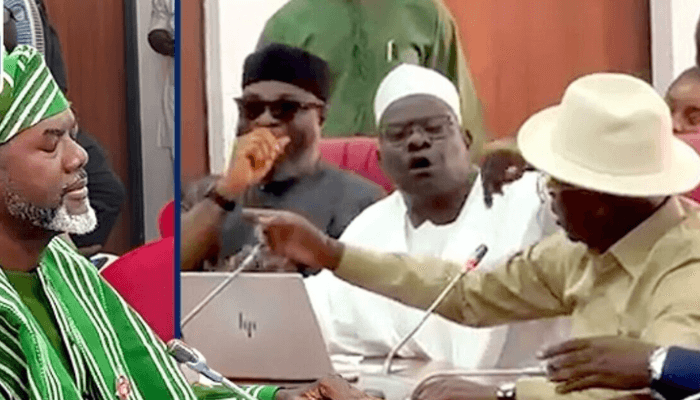
What should have been a rigorous examination of President Bola Tinubu’s ambassadorial nominees collapsed into drama, pettiness, and political theatrics, climaxing in a shameful verbal skirmish between Senators Ali Ndume and Adams Oshiomhole over the most unlikely subject; Reno Omokri.
Read also: Oshiomhole, Ndume clash as Senate screens Omokri, Dambazzau, Mahmood, others
From the very beginning, the screenings were doomed by a mixture of lethargy, misplaced loyalty, and an alarming unwillingness to do the job constitutionally assigned to the legislature.
Wednesday began with what felt more like a casual Zoom check-in than a national screening exercise.
Emmanuel Adeyemi, the Ekiti nominee who chose to appear virtually, opened confidently, presenting the Senate with an impressive record. But the session quickly derailed after he attempted to pay homage to senators from his state.
In Nigeria’s political culture, such courtesy is routine. Yet Adeyemi managed to turn it into a personal disaster when he named two of Ekiti’s three senators; Senate Leader Opeyemi Bamidele and Senate Spokesperson Yemi Adaramodu while completely forgetting the third, Senator Cyril Fashuyi.
The committee room froze. In a Senate where perceived disrespect can ignite an inferno, the omission was treated as a breach of protocol. What should have been a minor mistake escalated into a long, unnecessary argument.
Adeyemi tried to apologise, senators accused him of selective loyalty, and what was meant to be a diplomatic evaluation deteriorated into a petty quarrel about recognition. Eventually, Adeyemi was told to “take a bow and go,” passing through the process.
But the real spectacle of the day emerged when the tension between Senator Ali Ndume and Senator Adams Oshiomhole exploded on the floor.
The meeting room descended into a noisy, embarrassing confrontation as both men went at each other with astonishing personal venom, all in the course of defending, attacking, or referencing Reno Omokri, a man who has long hovered on the fringes of Nigeria’s political discourse. he clash was as bizarre as it was undignified.
Ndume, at one point, insinuated that Reno Omokri’s criticisms of the Senate were being championed or amplified by some senators who lacked the moral standing to confront him. Oshiomhole, fiery as always, sprang to Omokri’s defence, not because of ideological affinity but because he felt the chamber should not be dragged into personal quarrels with private citizens. Words flew, tempers flared, and the screening room, already mocked for its softness toward nominees, now became an arena for personal grudges and chest-thumping.
Staffers watched in discomfort, journalists exchanged glances, and Nigerians once again saw their lawmakers fight over personalities instead of policies.
The fact that the altercation happened during what should have been a serious assessment of diplomatic nominees made it even more jarring. It was a reminder that the Senate is increasingly prone to internal brawls that overshadow its real work.
Read also: Omokri, Fani-Kayode, others scale Senate committee screening as Oshiomhole, Ndume clash
If Wednesday was embarrassing, Thursday was far worse; the complete collapse of screening as an institution. One by one, nominees walked in, stated their names, and were waved away with the same refrain: “We know you.” Not one question was posed. Not one probing inquiry. Not one attempt to test competence.
The Senate did not pretend to review credentials, ask about diplomatic crises, or even evaluate basic temperament. It was the fastest conveyor belt of approvals in recent memory.
Shockingly, even nominees whose public conduct has raised legitimate concerns were passed without scrutiny. Among them was one individual notorious for uncontrolled public outbursts and repeated displays of anger, the sort of behaviour that should disqualify anyone from diplomatic service.
Diplomacy requires calmness, restraint, and emotional maturity, yet the Senate, in a stunning show of indifference, allowed him to “take a bow” without probing how he might handle conflict or pressure in a foreign capital. It was legislative negligence disguised as courtesy.
The emptiness of Thursday’s session raises the unavoidable question: what exactly will the Senate Committee on Foreign Affairs present as a report next week?
Reports are usually detailed documents reflecting the committee’s observations, concerns, and recommendations. But this time, the only truthful account would be a one-page script saying nominees showed up, introduced themselves, exchanged pleasantries, and left. To pretend otherwise would amount to falsifying the integrity of legislative oversight.
The Senate’s behaviour mirrors a deeper institutional problem: its unhealthy closeness to the executive and its unwillingness to challenge nominees who are politically connected.
Senators repeatedly told nominees, “We know you,” as if familiarity were a substitute for competence. That closeness is precisely why the chamber fails in moments that require courage. A screening exercise is not supposed to be a reunion of friends; it is meant to assess people who will represent 200 million Nigerians on the global stage.
But with the kind of performance displayed this week, one is forced to ask: why bother at all? Why waste time, energy, staff resources, and national attention on a process that senators themselves have no interest in carrying out? If the goal is simply to ratify whatever list the Presidency sends, the Senate might as well spare Nigerians the theatrics and announce publicly that it has abandoned its screening powers.
The tragedy is that the cost of this negligence will not be paid in the national assembly chambers.
It will be paid in foreign capitals where poorly vetted ambassadors will struggle to articulate Nigeria’s interests, mishandle diplomatic crises, or embarrass the country through unprofessional conduct. At a time when Nigeria’s global image is fragile, when the economy needs foreign partnerships, and when citizens require strong consular services abroad, the Senate has chosen political comfort over national responsibility.
This week’s ambassadorial screening was not simply poor, it was a disservice. Between Zoom blunders, petty ego fights, open-floor shouting matches, and perfunctory approvals, the Senate exposed how much of its constitutional authority it has surrendered.
Read also: Biya, Ouattara’s re-election, Africa’s worsening image, and Oshiomhole’s gauntlet
When lawmakers fight themselves more passionately than they question nominees; when defending Reno Omokri becomes more spirited than evaluating ambassadors; when “we know you” becomes more important than “are you competent?” the institution has lost its bearing.
Nigeria deserves a Senate that asks questions, not one that avoids them. Diplomacy deserves seriousness, not familiarity. And the country deserves ambassadors chosen on merit, not nominated through connections and waved through without scrutiny.
What happened this week was not screening. It was theatre. And in a season where Nigeria needs the Senate at its strongest, it is heartbreaking to watch the institution choose weakness.