


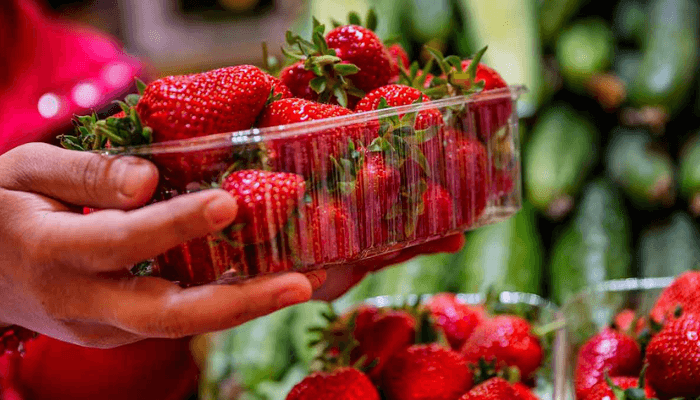
As early as 5am, farmers in rural Vom in Jos Plateau state set out to their strawberry farms. With torchlights strapped to their foreheads, they pick the delicate berries while the air is still cool. The earlier they are done picking, the earlier the trucks can move. Strawberries are at their best when cold, and any delay risks bruising or rot.
But once the berries leave the farm, the real problem begins.
After a careful harvest, the journey out of the farm to the big city buyers is precarious. With no direct flights, farmers rely entirely on road transport to reach markets. What leaves the farm vibrant and firm often arrives softened, leaking, or outright unsellable.
Read also: Bumper harvest turns sour as low purchasing power, poor storage hurt farmers
Peak season, dipping demand
Nigeria’s strawberry production is relatively infantile. Official production figures are unavailable publicly but market report from intelligence company, Essfeed shows that Nigeria produces around 3,000 tons of strawberries annually. The industry is valued at approximately $2 million, with local markets being the primary focus.
Tridge, a market intelligence company reports that strawberry harvest season in Nigeria begins to peak in December with over 70 percent of total production coming from Chaha district in Vom, Jos South Local Government of Plateau State.
The berry’s derivative is used in jams, smoothies, parfaits and fruit juices, and is also consumed directly.
Yet those in the business are meeting the season with more worry than excitement.
Bwai Grace, a local produce procurer in Jos, told BusinessDay that gaps in logistics and other infrastructure have “seriously” weakened demand. She now struggles to meet orders from Maiduguri, Katsina and even parts of Port Harcourt reachable only by rough roads.
With no cargo flights, farmers typically loaded their strawberries onto passenger planes, hoping the boxes are kept near the air conditioner. But when airlines such as Arik and Max Air halted flights to Plateau State, the chain collapsed, leaving them stranded and scrambling for improvised road transport.
“For years, Arik was the only lifeline. We paid more per kg in air cargo than we paid farmers per kg of produce. Logistics cost more than the fruit, and we still paid for it, because at least the berries arrived fresh and wholesome across the country,” said Deola Balogun, chief operating officer at Limlim Foods Production Ltd in a LinkedIn post.
“But overnight, it collapsed, Arik stopped flying into Jos in October. ValueJet is now the only carrier flying out from Jos, and they refused to carry strawberries,” Balogun added.
Grace explained the alternative. “I have someone with a deep freezer that uses an inverter. I wash the strawberry very well with water level at 11.5 pH to preserve the taste, then freeze them in kilos and cover with styrofoam so it doesn’t drip,” she said.
Her efforts could only do so much. Long hours on hot, uneven roads stress the fruit and a breakdown or checkpoint delay thins the line between a marketable carton and a total loss. “The weather outside Jos is really hot. And once you start changing the environment, the food will start becoming stressed and struggle to breathe,” she said
Many of the cartons of strawberries eventually arrive “not looking like food” and clients demand refunds.
“At some point last year, in February, I had to even close business for a very long time. I just told them, let me just travel and clear my head,” she said.
Balogun also recounted losing 20 to 30 percent of her produce due to checkpoint delays and rough roads that broke the boxes.
“Road is not a solution today. It’s a controlled disaster. We’re not losing strawberries because farmers don’t know how to grow them, we’re losing them because a berry’s entire value chain depended on a plane we didn’t control,” she said.
Hopi Afrique, a Nigerian farm produce business based in Jos, does not hide the vulnerability. Under its listing on Flutterwave, it wrote boldly, “Some of your strawberries will bruise or melt in transit.”
According to Tridge, Nigerian strawberries are currently sold at $3.64 per kg in wholesale markets. Grace said she sells her strawberries sell for N18,000 per 5kg.
Hopi Afrique estimates a carton at roughly 5.5kg, which means losing even ten boxes wipes out close to N200,000 in addition to transportation costs.
Read also: Farmers harvest losses as input cost soars 41%
Plugging the gap
The gap in prices ultimately tilts the market towards imports, keeping Nigeria on a costly cycle of bringing in the very strawberries it already grows.
In 2023, the country spent up N600million to import fresh strawberries, 80 percent of which came from Niger, according to data from The World Bank and the United Nations. South Africa, Belgium, Denmark were other major sources.
“If Plateau produces approximately 700 tons this season and we lose 50 percent due to lack of movement, 350 tons will rot in 120 days. By April, Lagos will import strawberries, puree and concentrate while fresh berries rot in Jos,” Balogun said.
The real fix, according to Grace, is reliable, temperature-controlled vans and cargo planes that are “very fast” to preserve strawberries during transit out of Jos.
However, the issue must first be resolved on the farm, she said.
Recently, security worries have altered the harvest routine. Instead of picking at dawn, which is the ideal time to retain firmness, farmers now wait until it’s safer to move around. That later start means the fruit hits the sun earlier, warming up long before it reaches any buyer.
The farms also require consistent water supply through boreholes and overhead tanks to replace the more tedious process of sourcing water from distant streams with pipes.
At the top of the priority for farmers is also access to affordable, high-quality fertilisers. Grace said that getting organic fertilisers is not cheap and farmers have to liaise with “someone abroad” to get the best and use them on their farms.
Balogun says without these measures, “[Nigeria] will keep planting pride and harvesting loss.”