


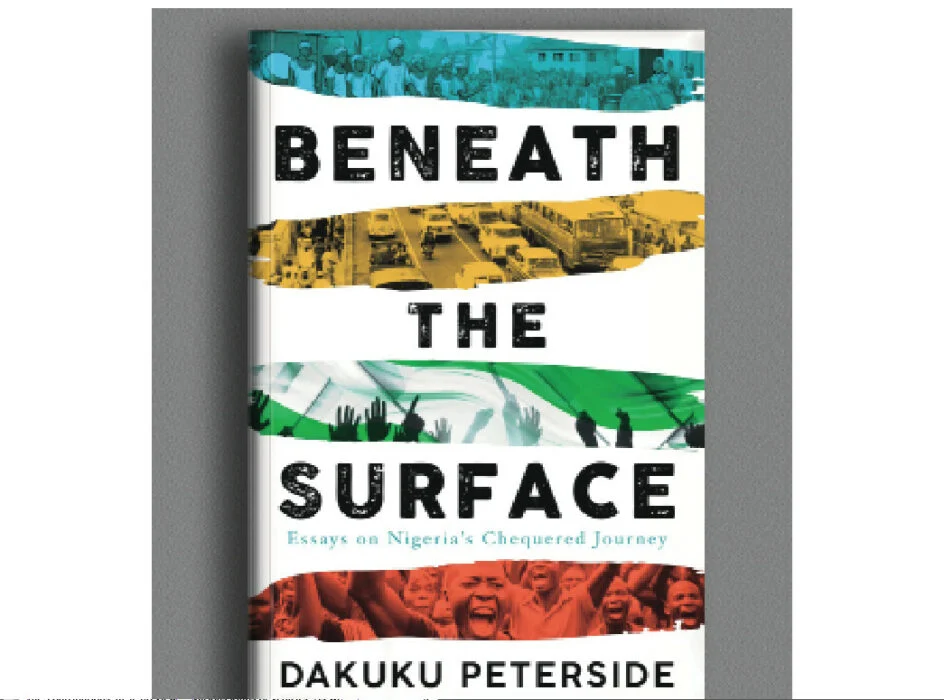
Professor Joseph A. Ushie, FANA, a distinguished academic and former Dean of Arts at the University of Uyo, has offered an insightful and comprehensive evaluation of Dr. Dakuku Peterside‘s recent publication, Beneath the Surface – Essays on Nigeria‘s Complex Journey. In his detailed critique, Professor Ushie highlights the depth and perceptiveness embedded in this compelling anthology of essays.
Beneath the Surface – Essays on Nigeria’s Chequered Journey is a carefully curated collection of 70 essays authored by Dr. Dakuku Peterside, a seasoned expert in public policy and governance reform, as well as a prominent voice on Nigeria’s developmental issues. Released in 2025 by Makere Publishers in Lagos, this extensive 496-page volume is organized into six thematic sections. Given the richness and intricacy of the essays, condensing the entire work into a brief summary would be akin to emptying an ocean with a teaspoon. Yet, even a cursory look at the chapter titles reveals the wide-ranging topics addressed.
The book’s cover art serves as a powerful visual allegory for Nigeria’s historical trajectory, mirroring the thematic core of the essays. It showcases four vertically stacked images, each representing a pivotal era in Nigeria’s evolution. At the top, the Green-White-Green flag waves behind palm trees, symbolizing the hopeful dawn of Nigeria’s 1960 independence. Below this, a lively urban scene teeming with vehicles and pedestrians captures the early momentum of post-independence modernization. The third image portrays a group of diverse Nigerian youths gazing forward with determination, embodying the nation’s aspirations. The final image at the base depicts a sea of passionate protesters with raised fists, reflecting the widespread discontent and unrest that have characterized recent times. This visual sequence narrates the book’s central thesis: beneath the initial optimism and early progress lies a layered reality of persistent challenges and societal tensions.
The first section, titled “The People and the State of the Nation,” contains 19 essays that explore pressing social concerns such as food insecurity and education. Dr. Peterside draws attention to the stark reality of hunger in Nigeria through essays like “Hunger Republic of Nigeria” and “Hunger Is Real and Present.” Other urgent topics include erratic power supply, the mass migration of young Nigerians-popularly known as the “Japa” phenomenon-moral decay, and the critical need to promote women’s leadership. The second section, “Governance and Leadership Issues,” features 13 essays that provide a forthright examination of Nigeria’s political landscape. Highlights include analyses of the judiciary’s systemic flaws, debates on the sustainability of democracy in Nigeria, commendations of Borno State Governor Babagana Zulum‘s leadership, and discussions on advancing gender equality legislation.
Part Three, “Elections, Politics and Power,” comprises nine essays that reveal hidden facets of Nigeria’s electoral system often overlooked by the general public. Noteworthy chapters include “Crowd for Hire,” “Manifestoes that Will Not Manifest,” “Judicial Intervention as Extension of 2023 Elections,” “Unwritten Rules of the 2023 Elections,” and “Security and the 2023 Campaigns.” This section, alongside Part Four, “Crime, Violence and National Security,” which also contains nine essays, delivers the book’s most intense and urgent commentary. Part Four tackles critical issues such as terrorism, the #EndSARS movement and its implications for Nigeria’s future, the alarming rise in ritual killings, the spread of mob justice, ongoing conflicts in Plateau State, and the pervasive threat of kidnappings.
In Part Five, “Economy and Development Interventions,” Dr. Peterside shifts the focus to Nigeria’s economic challenges and potential solutions. This segment’s nine essays address topics like “Reviving the Nigerian Middle Class,” “Accountability Deficit and Transparency Concerns,” “A Generation Ambushed by Substance Abuse,” “The Idolization of Petrol,” “Navigating Economic Hardships,” and “Two Global Wars and Nigeria’s Economic Struggles.” These essays resonate profoundly with those familiar with Nigeria’s socio-economic landscape over the past two decades, offering not only sharp analysis but also actionable recommendations for progress.
The final section, Part Six, broadens the lens to Nigeria’s position within the global arena. Dr. Peterside explores international developments and their significance for Nigeria in essays such as “Lessons from Chad,” “Niger: Turmoil in the Neighborhood,” “Secessionist Movements in Nigeria and the Israeli-Palestinian Parallel,” “China’s Leadership Model and Nigeria’s Context,” “From Nairobi to Nigeria: Kenya’s Election as a Reflective Case,” and “Zelensky, Ukraine, and Insights for Nigerian Leadership.”
Collectively, this anthology offers a sophisticated historical and contemporary analysis of Nigeria’s multifaceted challenges, tracing their roots and current manifestations with eloquence and clarity. Beneath the articulate narrative lies a hopeful vision for national renewal and transformation. Dr. Peterside’s essays serve as a rich repository of thoughtful solutions, making this volume indispensable for anyone seeking to understand and shape Nigeria’s future. Owning this book is like possessing a detailed chronicle of Nigeria’s last thirty years, inviting readers to revisit past struggles while uncovering the underlying causes of underdevelopment and pathways toward resolution.
Reflecting an African proverb, “One house owns the cock, but the village owns its voice,” Dr. Dakuku Peterside emerges as a singular yet resonant voice for Nigeria, reaching a global audience through this collection. The book has garnered praise from notable figures worldwide. Kenyan scholar Professor P. L. O. Lumumba describes it as “a rich tapestry of rigorously researched essays that challenge readers to confront the complex socio-economic and political barriers hindering Nigeria’s advancement.” Mohamed Ibn Chambas, African Union High Representative for Silencing the Guns in Africa and former ECOWAS Commission President, commends it as “a thorough, reflective, and scholarly exploration of Nigerian, African, and global affairs.” Bishop Matthew Kukah praises the work as “a vibrant mosaic of compelling themes expressed in elegant prose, opening new avenues for envisioning Nigeria’s future.” Other esteemed endorsers include Dr. Kayode Fayemi, Professor Emeritus Anya O. Anya, and Professor Kyari Mohammed.
In conclusion, Beneath the Surface – Essays on Nigeria’s Chequered Journey represents a monumental contribution from a uniquely insightful mind deeply acquainted with Nigeria’s complexities. As the saying goes, “Seeing is believing,” and in this case, reading this book is truly an act of believing.
Joseph A. Ushie, Professor of Linguistics and former Dean of Arts, University of Uyo